Ayurveda: Ancient Wisdom for Modern Wellness
Experience authentic Ayurvedic Healing combining traditional wisdom with modern diagnostics for holistic health
Page Summary
Ayurveda: Ancient Wisdom For Modern Wellness At A Glance
Ayurveda seeks to balance the three doshas — Vata, Pitta and Kapha — to harmonise body, mind and spirit, combining classical methods with modern diagnostics such as lab tests and imaging. Diagnosis starts with your constitution (Prakriti) and the classical tenfold and eightfold examinations, and treatment follows a set course: preparation with Snehana and Swedana, Panchakarma and therapies such as Abhyanga, Pizhichil and Shirodhara, then post-treatment care. Herbal medicines are made under physician supervision, and diet and daily routine are tailored to your constitution and digestion. MyVaidyam helps you choose the right therapy and the best-matched healing centre for your condition and goals.
Introduction to Authentic Ayurveda
India is a top spot for traditional Ayurvedic healing, especially in areas renowned for their mastery of ancient therapies. We focus on classical Ayurvedic methods but also bring in modern diagnostic tools like lab tests and high-tech imaging to help practitioners assess conditions accurately.
Our Treatment Philosophy
Our treatment philosophy prioritizes authenticity. All herbal remedies are carefully crafted under the supervision of skilled physicians, sticking closely to ancient texts. The treatments we offer—including oral medications, physical therapies, and topical applications—are given only after thorough consultations with our doctors.
Our Facilities & Expertise
Our facilities include a fully stocked in-house pharmacy and five well-equipped therapy rooms dedicated to patient care. Experienced therapists carry out all traditional treatments, including the famous Panchakarma protocols, under the watchful eye of physicians. We also tailor therapeutic yoga practices to meet each patient's unique health needs.
Foundational Principles of Ayurvedic Science
An effective practitioner should encompass wisdom and insight to shed light on a patient's internal health, which is key to tackling ailments. An accurate assessment is fundamental to achieving successful treatment outcomes.
Understanding Prakriti (Constitutional Type)
The Ayurvedic diagnostic approach starts with identifying an individual's constitutional type—known as Prakriti. Recent genomic studies have backed the biomedical validity of this constitutional evaluation. Health is viewed as a personalized, relative state, and understanding one's Prakriti helps clarify why some individuals get certain diseases while others do not. By determining Prakriti—based on a mix of psychophysical traits and sociocultural influences—practitioners can guide each person towards achieving their best health. Patients need to follow personalized advice from doctors to attain and maintain their ideal health.
The Five Elements (Panchamahabhoothas)
Ayurvedic philosophy teaches that everything in the universe is made up of five eternal elements, collectively known as Panchamahabhoothas: earth, air, fire, water, and space. Humans are seen as microcosms of this universal structure. These five elements, combined with consciousness, create living beings. Each element exhibits unique traits and exists in our bodies as Thridoshas—Vatha, Pitha, and Kapha. The focus of Ayurvedic wisdom is to balance these three fundamental forces to harmonize body, mind, and spirit.
Three Mental Qualities (Triguna)
Just as the three doshas make up our physical being, three mental qualities—Satva, Rajas, and Tamas—form the core of our psychological makeup. Everyone has different proportions of these qualities, with the dominant trait shaping their mental state.
Seven Body Tissues (Sapta Dhatus)
In addition, there are seven Dhatus (body tissues) that provide structural support: Rasa, Rakta, Mamsa, Medha, Asthi, Majja, and Sukra. While these tissues are essential for structure, Ayurveda also recognizes three biological systems—Vatha, Pitha, and Kapha—whose proper functioning guarantees effective nourishment and vitality. When these systems are out of balance, it leads to Dhatuvaishamya (disruption), resulting in various health issues. In simple terms, when doshas are unbalanced, it leads to tissue dysfunction.
Understanding Your Unique Constitution
Everyone has a unique combination of physical, mental, and emotional traits, which is their constitution, shaped by numerous internal and external factors like diet, climate, emotional tendencies, work demands, and family dynamics. Straying from one's natural constitution indicates disease or dysfunction. Ayurvedic treatment aims to restore this balance through herbal remedies, dietary changes, physical therapies, and spiritual-psychological healing.
The Three Doshas (Tridosha)
Vatha (Wind Energy)
Vatha is about subtle movement, consisting of air and space. It governs processes like breathing, muscle actions, heart rhythm, and cell activity. When balanced, Vatha fosters creativity and adaptability; when it's off, it can lead to fear and anxiety.
Kapha (Phlegm Energy)
Kapha serves as the body's structure, comprising earth and water elements. It keeps all systems hydrated, lubricates joints, moisturizes the skin, and supports immune health. Balanced Kapha brings love, tranquility, and compassion; imbalanced Kapha can lead to greed and jealousy.
Pitha (Bile Energy)
Pitha is the body's metabolic fire, made up of water and fire elements. It regulates digestion, nutrient absorption, metabolism, and temperature. When balanced, Pitha nourishes intelligence and comprehension; when it's unbalanced, it can lead to anger and hostility.
The Three Mental Qualities Explained
Rajas (Motion & Stimulation)
Rajas signifies motion and stimulation; all cravings and ambitions arise from this quality. Many psychological issues can stem from an imbalance in Rajas.
Satva (Clarity & Awareness)
Satva represents lightness, awareness, and clarity of mind, remaining free of disease. It's essential for perception, enabling knowledge gain.
Tamas (Heaviness & Inertia)
Tamas represents heaviness and inertia, which can interfere with perception and mental function. Confusion, misunderstandings, lethargy, and excessive sleep can all result from tamasic influence.
Ayurvedic theory posits that an imbalance in Vatha, Pitha, and Kapha leads to disease. Assessing patients involves exploring disease causation (nidana), early symptoms (purvaroopa), primary manifestations (roopa), therapeutic exploration (upasaya), and disease progression (samprapthi).
Tenfold Assessment (Dasavidha Pareeksha)
This consists of:
Eightfold Assessment (Ashtasthana Pareeksha)
This includes examining:
Ayurvedic Medicinal Preparations
Ayurvedic medicines mainly use herbs and plant combinations, following traditional pharmacological methods. Forms include:
Four Essential Elements for Disease Cure
Classical Ayurvedic texts highlight four key components for recovery: skilled Physicians, effective Medicaments, proficient Nursing support, and cooperative patients.
Physician Qualities:
Medication Qualities:
Nursing Qualities:
Patient Qualities:
Nutritional Approach
In Ayurveda, food is seen as essential to life. Proper digestion, influenced by digestive fire (jataragni), fuels the creation of seven life-sustaining tissues (sapthadhatus). We tailor dietary strategies based on individual constitution, focusing on digestive capacity rather than just calorie counting. Dietary mistakes are a major cause of disease, and following the dietary guidelines, called Pathya, is essential.
Daily Routine (Dinacharya)
Ayurveda advises daily living practices called Dinacharya, outlining routines from morning to bedtime.
Morning Awakening:
It's advised to get up before sunrise. After morning prayers, attend to natural needs, then brush teeth thoroughly, rinse the mouth, eyes, and face with water.
Bathing:
Cold baths help remove impurities and purify blood. Warm herbal baths have more localized benefits, and steam baths can ease pain.
Attire & Environment:
Wear clothing appropriate for the weather—warm in winter, light in summer. Clean living spaces and well-ventilated rooms are equally important.
Rest & Activity:
Getting enough good-quality sleep maintains health. Daytime sleep is generally discouraged. Ayurveda recommends physical activities to boost strength and keep the body fit.
Traditional Therapeutic Procedures from India
Preparatory Treatments (Poorva Karma)
Preparatory treatments are essential for getting patients ready for Panchakarma. Snehana (oleation) and Swedana (sudation) are two key preparatory steps.
Panchakarma
Panchakarma is a unique purification process with five therapies designed to completely detoxify the body: Vamana (Emesis), Virechana (Purgation), Vasthi (Enema), Nasya (Nasal administration), and Rakthamokshana (Bloodletting).
Abhyanga
Abhyanga is about massaging the body with medicated oils using gentle pressure. This ancient massage helps ease body stiffness and pain, allowing for smoother movements by eliminating metabolic waste and enhancing blood flow.
Pizhichil
Pizhichil is a specialized treatment that promotes perspiration by pouring warm medicated oil in specific patterns, achieving both Snehana and Swedana effects at once. This method stimulates the neuromuscular system and nourishes the body.
Shirodhara
Shirodhara involves the continuous pouring of medicated oil or liquid over the forehead. The constant flow of liquid relaxes and calms the mind, making it excellent for stress and anxiety.
Upanaham
Upanaha is a sudation technique where a warm herbal paste is applied to specific areas and then wrapped. This method provides localized heat, alleviating swelling and pain.
Kizhi Treatments
Pathra Pinda Sweda/Elakizhi
This sudation uses specially prepared medicinal leaf packets (boluses). This method combines heat and medicated oil to strengthen the neuromuscular system while relieving pain and inflammation.
Churna Pinda Sweda/Podikizhi
This method uses powdered herb packets applied after heating. The treatment stimulates nerve endings, relaxes muscles, and alleviates pain.
Njavarakizhi
This specialized treatment uses heated Njavara rice pudding boluses applied externally. This procedure offers a blend of massage, heat, and pressure that nourishes muscles and nerves.
Shirolepana
This involves applying a medicinal paste to the head. It promotes cranial tranquility, soothes the mind, and nourishes brain cells.
Shirovasthi
Shirovasti retains medicated oil on the head using a cap for a specified time to nourish and treat conditions related to the head and nervous system.
Kativasthi
Kativasthi retains warm medicated oil over the lower back to nourish nerves, muscles, and joints in the area, providing relief from pain.
Uro Vasthi
Uro Vasthi involves keeping warm medicated oil on specific areas of the chest to foster nourishment and support in the targeted areas.
Akshi Tharpana
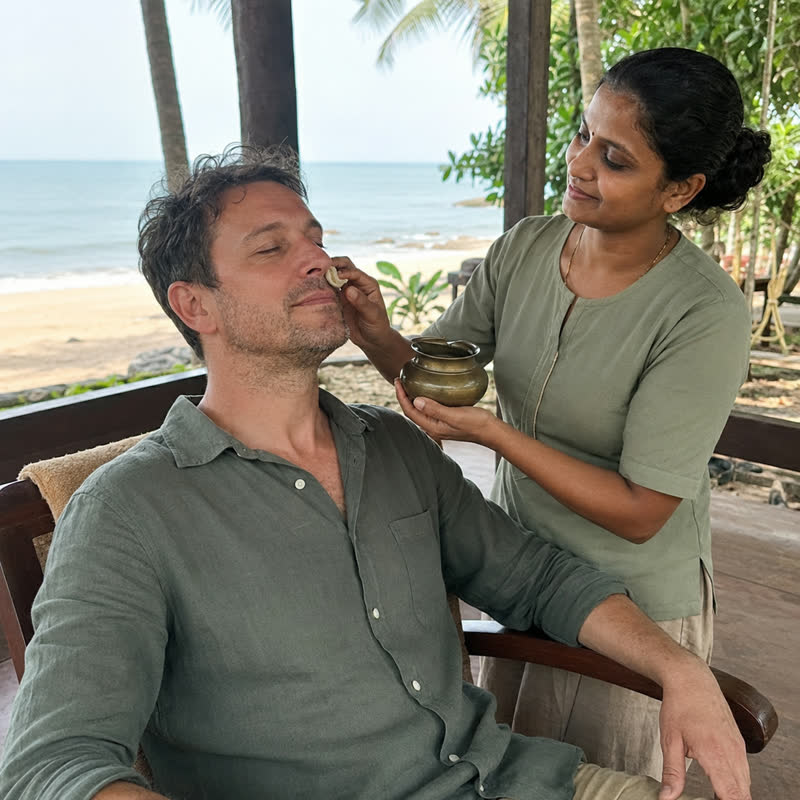
In this process, medicated ghee is kept over the eyes to nourish the ocular structures and strengthen the optic nerves.
Post-Treatment Protocol (Paschath Karma)
After treatment, patients are advised to rest. Paschath Karma helps patients regain their strength and return to normal. During this phase, they should use warm water, avoid physical and mental exertion, and take prescribed medicines to maximize effectiveness.
Key Facts – Ayurveda: Ancient Wisdom For Modern Wellness
Everything an international patient usually asks, on one screen.
- What It Is
- A system that balances the three doshas — Vata, Pitta and Kapha — to harmonise body, mind and spirit
- Approach
- Classical Ayurvedic methods with modern diagnostics such as lab tests and imaging
- Diagnosis
- Prakriti (constitution) assessment, with the tenfold (Dasavidha) and eightfold (Ashtasthana) examinations
- Therapies
- Panchakarma, Abhyanga, Pizhichil, Shirodhara, Upanaham, Kizhi, Shirolepana, Shirovasthi, Kativasthi, Uro Vasthi and Akshi Tharpana
- Course Of Treatment
- Preparation (Snehana and Swedana) → Panchakarma → post-treatment care (Paschath Karma)
- Medicines
- Herbal remedies prepared under physician supervision, following the classical texts
- Diet
- Tailored to your constitution and digestive capacity rather than calorie counting
- Daily Routine
- Dinacharya, with restful sleep and regular physical activity
Begin Your Ayurvedic Journey
Experience authentic Ayurveda treatments supervised by expert physicians. Let us guide you towards optimal health and balance.
Traditional Wisdom
5000+ years of authentic Ayurvedic knowledge and practices
Dosha Balance
Personalized treatments to balance Vata, Pitta, and Kapha
Modern Diagnosis
Advanced lab tests and imaging for accurate assessment