This guide looks at what panchakarma is, how a residential programme in India works, how it compares with what is typically available at home, and what to look at when you compare centres, so that your decision rests on clarity rather than guesswork.
Quick Facts - Panchakarma in India vs Switzerland
| Topic | Summary |
|---|---|
| What it is | A structured, doctor-planned set of cleansing and rejuvenating therapies |
| Stages | Preparation (purvakarma), main therapies (pradhana karma) and recovery (paschat karma) |
| Typical stay | 7, 14, 21 or 28 days |
| Led by | A registered Ayurvedic doctor with a recognised degree |
| What to compare | Doctor, personalisation, inclusions, diet, setting and follow-up |
| Regulation in India | National Commission for Indian System of Medicine (NCISM); Ministry of Ayush |
| Travel | Nonstop flights from Zurich to Delhi and Mumbai take about 8 hours, followed by a domestic flight, and connecting itineraries via Geneva typically total 11 to 16 hours |
What panchakarma is
Panchakarma means five actions, and it describes a family of cleansing and rejuvenating therapies that sit at the heart of classical Ayurveda. Rather than a single treatment, it is a carefully sequenced programme, designed by an Ayurvedic doctor after assessing your constitution, your health and the season. The aim is to support your body's own balance, ease the load on digestion and the nervous system and leave you better able to keep healthy habits at home.
Not every programme includes every therapy. A good doctor chooses what suits you, and sometimes a gentler programme of massage, steam, diet and rest is the right answer.
The three stages of a programme
A well-structured programme moves through three stages:
- Preparation (purvakarma). Oil-based therapies and herbal steam, together with a simple diet, gently prepare the body.
- Main therapies (pradhana karma). Depending on your plan, these may include therapies such as virechana, basti, nasya or others, chosen and supervised by your doctor.
- Recovery (paschat karma). A gradual return to normal food and routine, with guidance for continuing at home.
Each stage takes time, which is why programmes of two to four weeks are common, and why shorter stays are usually gentler.
What a residential programme in India feels like
Most guests stay at a centre for the whole programme. Days follow a calm rhythm: an early start, a consultation, treatments in the morning, simple freshly cooked meals, rest in the afternoon, perhaps yoga or a walk and an early night. Your doctor sees you regularly and adjusts the plan as your body responds. Because food, therapies, sleep and rest are all part of one plan, many guests describe the experience as immersive in a way that is hard to recreate with occasional appointments at home.
What is typically available in Switzerland
In Switzerland, you may find spas offering Ayurvedic-style massages, wellness centres with short Ayurvedic treatments and some practitioners who offer consultation and herbal advice. These can be lovely and relaxing, and they are a good way to experience the flavour of Ayurveda. They vary widely in training and scope, and they are usually delivered as single sessions or short courses rather than as a residential programme. For many people they are a wonderful introduction, and a stay in India is the next step.
Comparing the two, at a glance
| Aspect | Comparison |
|---|---|
| Format | India: residential programme over several weeks; home: single sessions or short courses |
| Led by | India: registered Ayurvedic doctor throughout; home: varies by provider |
| Personalisation | India: plan based on your constitution, adjusted daily; home: often standard treatments |
| Diet | India: meals prepared to suit your plan; home: usually your own food |
| Immersion | India: therapies, rest and routine together; home: fitted around daily life |
| Follow-up | India: review at the end and an agreed follow-up; home: depends on the provider |
Doctors and qualifications
In India, Ayurvedic doctors study for a BAMS degree (Bachelor of Ayurvedic Medicine and Surgery) and may continue to a master's or doctorate. Practitioners are registered, and the National Commission for Indian System of Medicine (NCISM) sets standards for education and practice. Ask each centre for the treating doctor's name and qualifications, and check the registration.
What to compare between centres
- The treating doctor's qualifications and how often you will see them.
- Whether the plan is personalised and written down.
- What is included: consultation, therapies, medicines, meals, accommodation and follow-up.
- Accreditation or recognition, such as NABH or Ministry of Ayush recognition.
- Privacy, hygiene and comfort.
- How clearly and kindly the team answers your questions.
Ask each centre for a written outline of these points, so that you can compare like with like.
Duration and continuity
Panchakarma works through sequence and rhythm, so time matters. A stay of fourteen to twenty-eight days allows preparation, main therapies and recovery to follow naturally. A week suits a gentler programme of massage, steam, diet and rest. Your doctor will recommend a length after reviewing your history.
Is it right for you?
Panchakarma is not for everyone, and a good doctor says so honestly. People who are frail, acutely unwell or pregnant should discuss their plans with their own doctor and the Ayurvedic physician first. Share your complete history and medicines so that the programme can be planned safely.
Planning the journey from Switzerland
Nonstop flights from Zurich to Delhi and Mumbai take about 8 hours, followed by a domestic flight, and connecting itineraries via Geneva typically total 11 to 16 hours. India is 4.5 hours ahead of Switzerland in winter and 3.5 hours ahead during summer time, so it helps to arrive a day early and keep the first day gentle. Apply for your e-Medical visa a few weeks ahead through the official portal, and book flights after approval. Swiss plugs are Type J and India uses 230V with Type C, D and M sockets, so your devices will work with an adapter.
Health coverage at home
Basic insurance (KVG/LAMal) is focused on care in Switzerland, with limited cover abroad, mainly for emergencies, so elective Ayurveda in India is not normally covered. A travel insurance policy with emergency medical and repatriation cover is a sensible protection for the trip. Keeping this in mind lets you plan calmly.
Common misunderstandings
| Misunderstanding | The reality |
|---|---|
| Panchakarma is a single treatment | It is a sequenced programme planned for you |
| A spa treatment at home is the same as a programme in India | They can be lovely but differ in scope, supervision and depth |
| Longer is always better | The right length depends on your health and goals |
| Panchakarma replaces my doctor | It is complementary and best used alongside your usual care |
| Every programme includes every therapy | Doctors choose what suits you |
Snehana: the role of oil
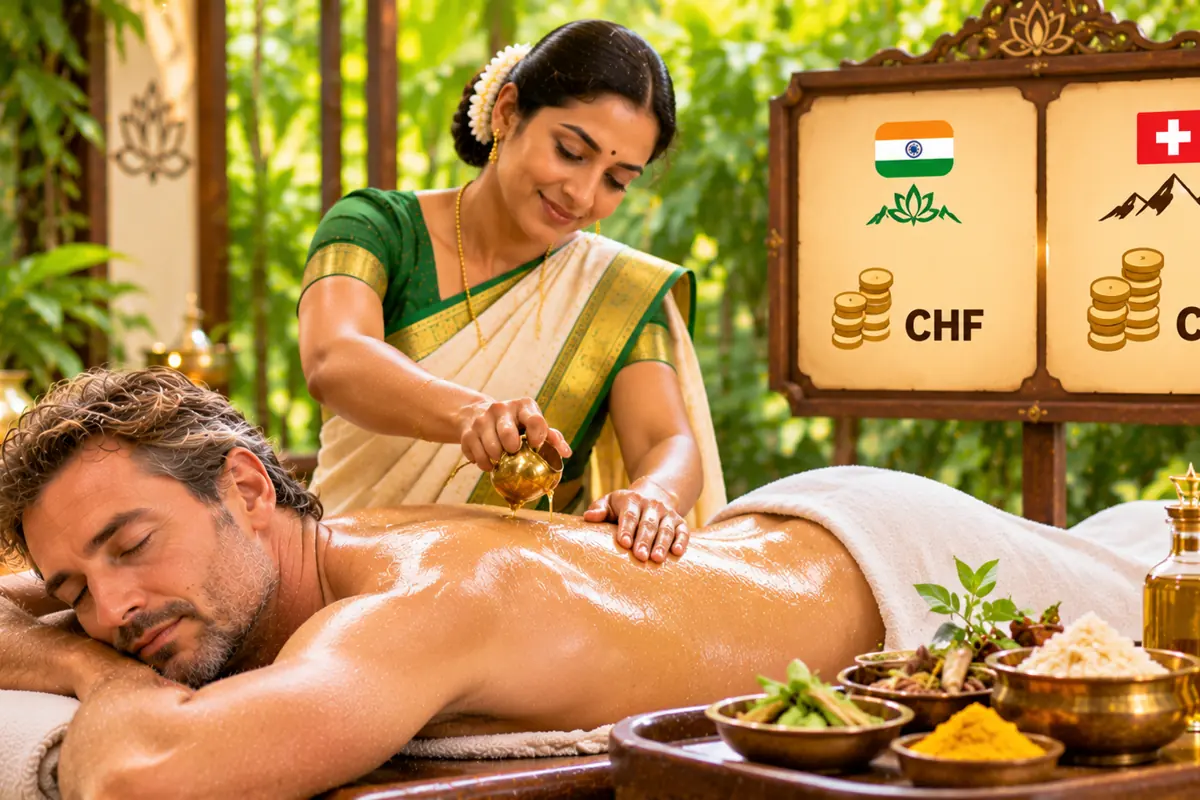
Oil therapies are a hallmark of Ayurveda. Warm herbal oil is applied externally, and in some programmes taken internally under supervision, to soften and prepare the body. Many guests find the massage deeply calming, and the oils are chosen to suit your constitution.
Swedana: herbal steam
After oil therapy, gentle herbal steam helps the body relax. Your doctor adjusts the duration and temperature, and treatment rooms are designed to be comfortable and private.
Diet during panchakarma
Meals are simple, warm and easy to digest, such as rice-based dishes, soups and cooked vegetables, and they change with the stage of the programme. Many guests find this the most transformative part, and take home a lasting sense of how food feels in the body.
Rest and movement
Gentle yoga, breathing practices and walks support the therapies, while rest allows the body to respond. Programmes are paced with care, so you are never rushed.
Seasons and timing
Many Swiss travellers plan their stay around the Swiss autumn and winter, when Kerala is cooler and drier, and traditional teaching favours certain seasons for cleansing. Your doctor can advise on the best timing for you.
Language and communication
Ask each centre what language support it offers, and prepare a short medical summary in English. A written plan helps your own doctor at home to understand your programme.
Questions for your first consultation
- What do you think panchakarma can realistically help with in my case?
- What would my programme include, and why?
- How will my plan change if I respond differently than expected?
- What should I do at home afterwards?
Preparing before you travel
Share your reports with the doctor, simplify your diet in the days before you travel if advised, arrange time off work and plan a gentle journey. Arriving rested makes the programme more comfortable.
After the programme
The weeks after panchakarma are part of the treatment. Your doctor will usually recommend simple foods, regular routines and a gradual return to activity. A follow-up call helps you stay on track.
Combining a programme with a holiday
Some guests add a few days of rest or sightseeing before or after the programme. Keep the programme itself calm, and add excursions only when your doctor agrees.
A note on realistic expectations
Panchakarma is a supportive, complementary approach. Many guests feel lighter, calmer and more energetic, but results vary, and no centre can guarantee outcomes. An honest doctor will explain what is likely in your case.
Keeping your own doctor involved
Tell your own doctor about your plans and share the Indian doctor's summary on your return, so that your care at home and in India fits together.
Taking your time
There is no rush to decide. Speak with a few centres, ask for written plans and choose the one that makes you feel most understood.
A few words on pacing
Many guests are surprised by how much the unhurried pace helps. Treat the first few days as a time to settle in rather than to achieve anything, and let the routine of meals, rest and treatment do its quiet work.
Staying connected with home
A local SIM or an international plan makes it easy to message family and share photos. A short daily call home is often enough to keep loved ones reassured and lets you enjoy the rest of your time fully present.
Keeping a simple journal
A few lines each evening about your sleep, digestion, energy and mood help you notice changes, and they give your physician useful detail at your next review. They also make a lovely record of your stay.
Dressing for comfort
Light cotton clothing in soft colours, comfortable sandals and a thin shawl or jacket for air-conditioned rooms suit most programmes. Your centre can tell you whether treatment robes are provided.
Asking questions freely
Good care is a conversation. Ask your physician to explain each treatment, the reason for each medicine and what to expect. A caring doctor will welcome your curiosity and adjust the explanation to what is most helpful for you.
How MyVaidyam can support you
MyVaidyam is happy to help you compare programmes and choose with confidence.
- An online consultation with an Ayurvedic physician to discuss your goals.
- Help comparing written plans from different centres.
- Guidance on choosing an accredited centre.
- Visa, travel and arrival support, and follow-up after you return.
You are welcome to reach out at any stage with questions.