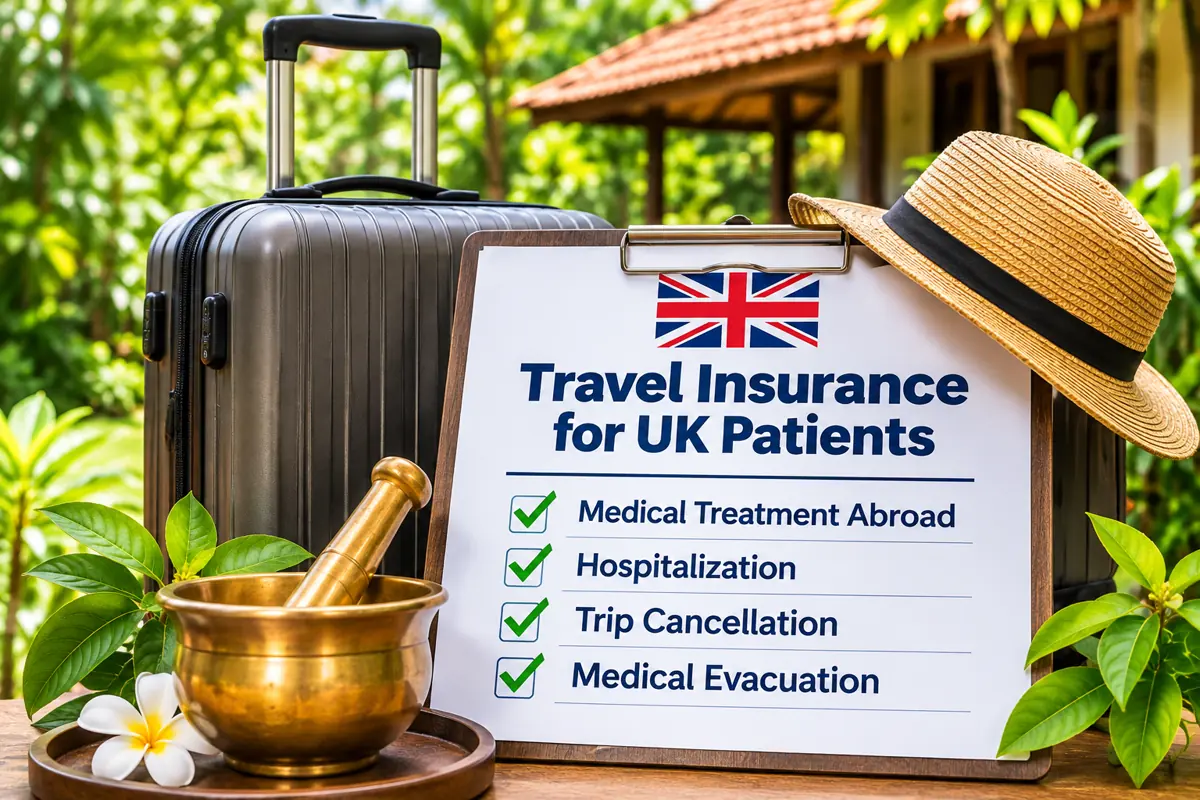
This guide explains what to look for in a policy, the questions worth asking, and how it fits alongside the NHS so that you can book with confidence.
Quick Facts - Travel Insurance for UK Patients Having Ayurveda Treatment in India
| Topic | Summary |
|---|---|
| Main health cover | the NHS |
| Elective Ayurveda in India | Generally not covered; confirm in writing |
| Travel insurance | Recommended for emergencies, delays and baggage |
| Documents often needed | Itemised receipts and a treatment summary from the doctor |
| Who decides | Your insurer or plan administrator |
| Safest approach | Plan to pay privately; treat any reimbursement as a possible bonus |
How the NHS usually treats this
The NHS funds care in the UK and, outside narrow schemes, does not pay for elective treatment abroad. The Global Health Insurance Card (GHIC) does not apply in India.
Private medical insurers usually do not cover elective Ayurvedic programmes, whether in the UK or in India. Policies differ, so ask your insurer for their answer in writing.
The kindest thing you can do for yourself is to ask your insurer or plan administrator directly, and to ask for the answer in writing. A short call or secure message to member services, noting the date and the name of the person you spoke with, gives you clarity and a record. If the answer is no, you can plan your budget without any doubt in your mind.
Travel insurance: your safety net for the journey
Travel insurance is the cover most UK guests rely on for the journey, covering emergencies, delays and lost baggage, and it is worth reading closely. Cover varies between policies, so it helps to compare a few and read the details.
- Emergency medical treatment and hospital costs in India.
- Medical evacuation and repatriation to your home country.
- Trip cancellation or interruption, including illness before you leave.
- Lost, delayed or damaged baggage and travel documents.
- Pre-existing conditions, which some policies exclude or cover only if declared.
- Whether planned, elective treatment is covered, since many policies exclude it.
Questions to ask your insurer
- Does my plan cover any care received outside the United Kingdom, and if so, under what conditions?
- Is treatment by an Ayurvedic practitioner a covered service in any circumstance?
- Will you confirm your answer in writing?
- What documents would I need to submit a claim, and what is the deadline?
- Does my travel policy cover my destination, length of stay and activities?
Documents to ask the centre for
Even if you do not expect reimbursement, collecting good paperwork costs nothing and keeps your options open. Ask your Indian centre for:
- Itemised receipts that list each service and the date.
- A summary of your diagnosis and treatment plan from the treating doctor.
- A copy of the doctor's registration details.
- Receipts in English, showing your name and the centre's address.
Telling your own doctor and insurer about your plans
Let your own doctor know about your travel plans, and mention any change in your health while you are away. If you have a condition that your insurer monitors, a brief note about your trip keeps everything transparent and avoids surprises later.
Budgeting with confidence
Many guests find that the simplest path is to treat the whole trip as a personal investment in their wellbeing. Set aside a comfortable budget for the programme, flights, visa, travel insurance and local spending, and add a small cushion for unexpected costs. This keeps your planning relaxed, and it means insurance questions never get in the way of your decision.
Pre-existing conditions
If you have an existing condition, declare it when you buy travel insurance. A policy that knows your history is far more likely to respond helpfully if you need it. Ask what is covered, what is excluded and whether a stable condition can be included for an extra premium.
Reading the small print
- Check the cover limits for medical expenses and baggage.
- Look at the excess or deductible you would pay.
- Find the 24-hour emergency phone number and save it on your phone.
- Note what you must do before treatment, such as calling the assistance company.
- Confirm the policy start and end dates cover your full trip.
If you need to make a claim
Keep every receipt, report and prescription, contact the insurer's assistance line as soon as you can, and ask for the claim form. Photographs of damaged luggage, a police or airline report for lost items and a doctor's letter for medical claims all help. Prompt, tidy paperwork makes a claim much easier.
Medical evacuation: peace of mind you hope never to use
Medical evacuation and repatriation cover pays for a medically supervised journey home if you ever need it. It is rarely used, but many travellers find the reassurance worth having, particularly for a longer stay.
Your own doctor's role
Share your Indian doctor's treatment summary with your own doctor on your return. It keeps your records complete, helps with any later claims, and means your care at home and in India fits together.
Choosing a policy that fits your trip
Compare a few options from your bank, an insurer or a travel agent, and choose one that matches your length of stay. Single-trip policies suit one visit, while annual policies suit frequent travellers. Read the reviews, check how claims are handled and keep your policy number with your passport.
What your trip insurance usually will not cover
Most travel policies treat planned, elective treatment as outside their scope, and they exclude losses from risky activities or from not following medical advice. Knowing this in advance helps you set expectations and plan your budget with clarity.
How MyVaidyam can support you
MyVaidyam is happy to help you plan your treatment and your journey in a clear, organised way, so that practical questions like this one are easy to answer.
- An online consultation with an Ayurvedic physician to discuss your goals.
- Help preparing itemised receipts and treatment summaries.
- Guidance in choosing an accredited treatment centre.
- Support with your visa, flights and arrival plans.
- A friendly point of contact during your stay and after you return.
You are welcome to reach out at any stage with questions.