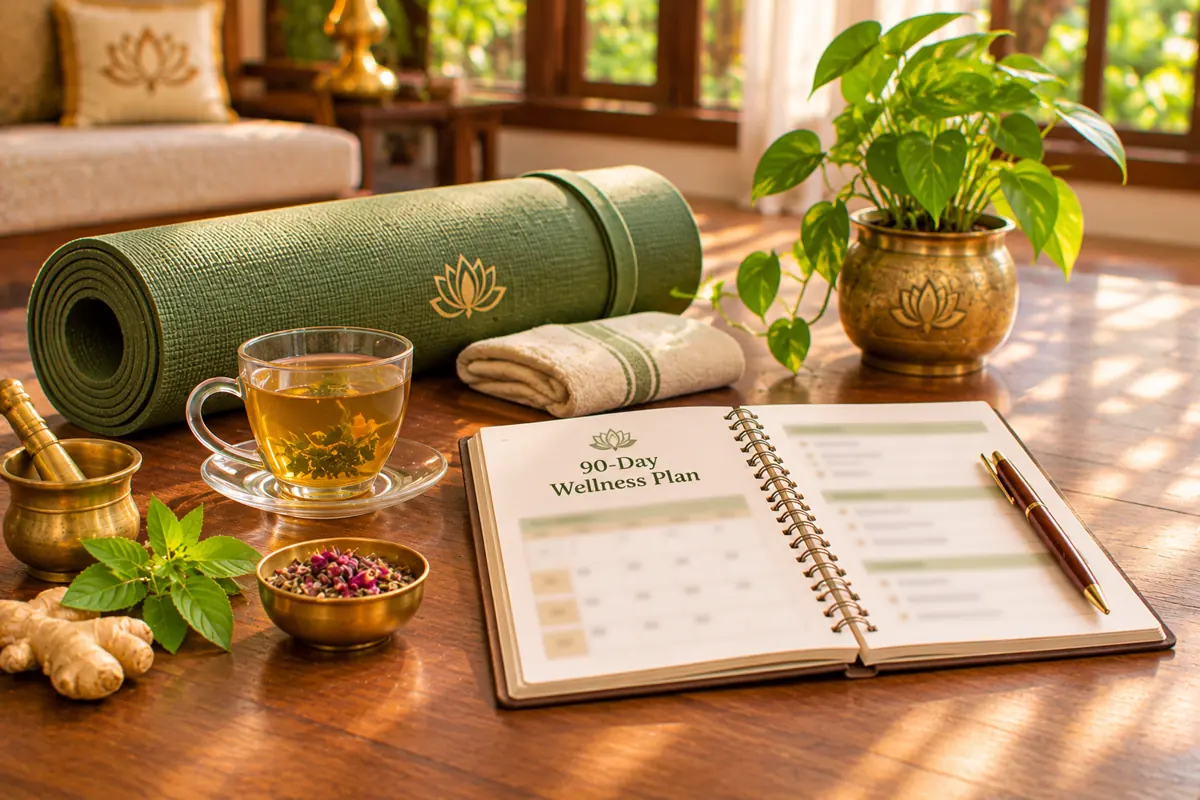
This guide explains in plain language how to build a 90-day plan after an Ayurveda stay: why your doctor shares in it, how to turn the centre's advice into a written plan, how to divide the time into stages, what to include for food, movement, sleep and calm, how to track progress kindly, how to handle setbacks, how to use follow-up with the centre and how to keep going afterwards. And throughout, it shows how MyVaidyam can walk beside you as your friend and guide.
Ayurveda is offered here as a complementary, supportive approach that works alongside your own doctor's care, never as a replacement for it. It makes no promises about any particular result.
Quick Facts - Building a 90-Day Post-Ayurveda Wellness Plan
| Topic | Summary |
|---|---|
| Purpose | Turning the stay's lessons into lasting habits |
| Length | Ninety days, in three stages of about a month |
| Core areas | Food, movement, sleep, calm, review |
| Tools | Written plan, simple diary, scheduled check-ins |
| Share with | Your own doctor and the centre |
| Not | A promise of any particular result |
| Visa | e-Medical visa: 60 days from first arrival, triple entry, non-extendable |
| Your companion | MyVaidyam: planning, coordination and support before, during and after |
Why ninety days
Habits are rarely built in a week, and rarely lost in a day. About three months is long enough for a new routine to start feeling natural, and short enough to hold in mind. Dividing it into three stages of about a month each gives you a rhythm of settling in, building up and making it your own.
A 90-day plan in three stages
1. Days 1 to 30: Settle
Routine, food, sleep, a daily walk
2. Days 31 to 60: Strengthen
More movement, strength, calm practice
3. Days 61 to 90: Sustain
Review, adjust, make habits yours
Each stage has a small number of clear tasks, so that the plan stays achievable.
Start with your doctor and the written plan
Before you leave, ask the centre for a written summary, food guidance and exercise routine. At your first follow-up, share them with your own doctor, and ask for any adjustments needed for your health and medicines. Continue every prescribed medicine, and keep regular reviews. A plan that your doctor and the centre both understand is much easier to follow.
How Ayurveda sees the weeks after
Ayurveda describes the period after a programme as one of consolidation, when food, rest and routine are kept regular so that the benefits settle, and the body slowly returns to ordinary life. It stresses a gradual return to normal food and activity, and regularity above intensity, which is exactly what a ninety-day plan encourages.
Stage one: days 1 to 30, settle
- Keep a regular bedtime, wake time and meal times.
- Eat warm, freshly cooked, light meals, with a light early supper.
- Walk daily, and keep a short breathing practice.
- Introduce foods and activities gradually.
- Keep your first doctor follow-up.
Stage two: days 31 to 60, strengthen
- Add strength work or yoga two or three times a week.
- Widen your food variety, one change at a time.
- Keep a regular weekly check-in on sleep, energy and weight.
- Review the plan with the centre online, if arranged.
- Protect time for calm, such as meditation or nature.
Stage three: days 61 to 90, sustain
- Review what has worked, and keep it.
- Drop or adjust what has not.
- Add one new habit that you enjoy.
- Plan for seasonal changes, holidays and busy periods.
- Schedule your next check-up or follow-up.
Food, movement, sleep and calm
Four anchors carry most plans: regular, warm, balanced meals; daily movement, built up gently; a steady bedtime with a screen-light evening; and a few minutes of calm each day. Choose a time and place for each, and write them in your diary. If life gets busy, protect the anchors first, and everything else second.
Tracking progress kindly
A short weekly note on sleep, energy, digestion, mood and habits kept tells you more than the scale alone. Review it monthly, celebrate what is working and treat dips as information, not failure. If you find tracking stressful, simplify it to a single question each week: how do I feel?
When life gets in the way
Illness, travel, work deadlines and family events will interrupt the plan. That is normal. Return to the routine at the next meal or the next morning, and avoid all-or-nothing thinking, which turns a small slip into a collapse. A plan that bends is better than one that breaks.
A day in the plan
| Time | What it might look like |
|---|---|
| Early morning | Warm water, a few minutes of breathing, a walk |
| Morning | Light, warm breakfast |
| Late morning | Work or activity, with a movement break |
| Midday | Fuller balanced meal, a short rest |
| Afternoon | Healthy snack if needed, a stretch |
| Evening | Light early supper, calm hour, early sleep |
Using follow-up well
Ask the centre what follow-up they offer, such as an online review at one month or three months, and put the dates in your diary. Prepare a short list of questions, share your diary and bring any new test results. Follow-up keeps the plan alive, and gives you someone to report to.
Taking it home, and keeping it
- Write down your plan, and keep it where you will see it.
- Choose a few anchors, and protect them.
- Review weekly, and adjust monthly.
- Share progress with your doctor.
- Stay in touch with the centre.
Setting honest expectations
Habits and health fluctuate over time, and no plan can promise that results will be maintained. A residential stay offers learning, structure and a fresh start, and what lasts is shaped by small daily choices, made with patience and kindness.
Setting goals that fit
Choose goals that are specific and kind: walk twenty minutes on five days a week, in bed by ten on weeknights, cook dinner at home four nights. Avoid goals that depend on a number alone. Write each one down, with the reason it matters to you, since a reason you care about carries you further than a rule.
Involving family and friends
Habits stick better when the household is on board. Share what you learned, cook together, walk together and ask for specific help, such as keeping a particular snack out of sight. Most families are glad to be asked, and often end up healthier themselves.
Questions to ask at day 30, 60 and 90
- How are my sleep, energy and digestion compared with the day I returned?
- Which two habits have been easiest to keep?
- What gets in the way, and how can I plan around it?
- What do I want to add, or drop, in the next month?
- What would I like to ask my doctor or the centre?
Working alongside your own doctors
Please keep your own doctors informed. Share your medical summary, bring your reports and keep taking whatever you have been prescribed. Please keep taking prescribed medicines, and discuss any changes to your plan with your own doctors. Please do not change medicines without medical advice.
Choosing a centre with follow-up
Look for a qualified Ayurvedic doctor (BAMS or MD Ayurveda), registered with the appropriate board, a written take-home plan and a clear follow-up system, such as scheduled online reviews. Be cautious of anyone who promises permanent results or sells products to carry the plan.
Planning the journey
Apply for your e-Medical visa on India's official portal, usually with a hospital letter, a few weeks before travel. It is valid for 60 days from first arrival, allows three entries and cannot be extended. Book flights after approval, arrange travel insurance and choose an arrival time that gives you a rested first day. Check the portal for current rules before you apply.
Your friend and hand-holder after you return home: MyVaidyam
A good plan starts with a good conversation, and that is where MyVaidyam comes in. We walk with you from your very first question to the day you return home, answering every question patiently and making sure that nothing is left to chance.
- An online consultation with an Ayurvedic physician to shape your 90-day plan.
- Help preparing your health summary and your doctor follow-up.
- Guidance on choosing a centre with a clear take-home plan and follow-up.
- Help turning the written plan into a simple diary and calendar.
- Support with your e-Medical visa documents, flights, airport pickup and accommodation.
- A warm point of contact after you return home, with follow-up as you settle back in.
You are welcome to reach out at any stage. We would be delighted to help you begin.