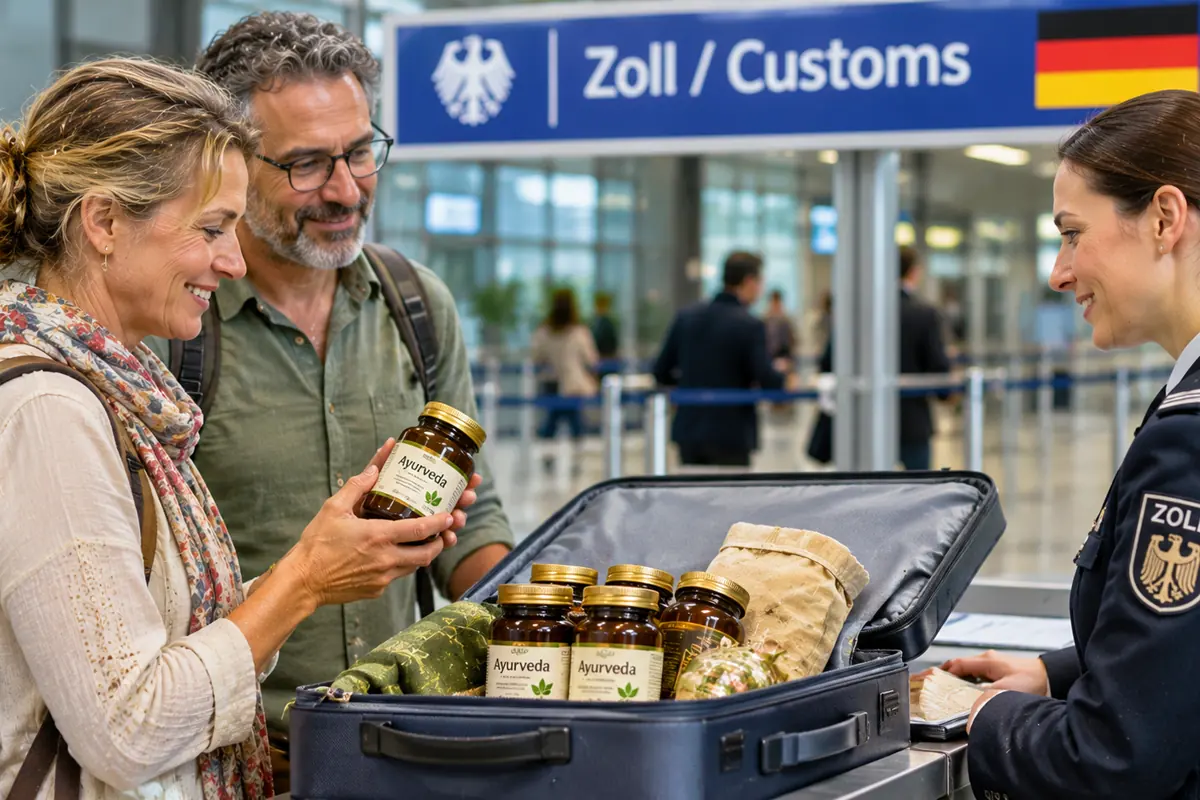
This guide explains who is involved on arrival in Germany, what the general principles are, and a simple checklist for your journey home. Rules are updated from time to time, so please confirm the current position with the Federal Institute for Drugs and Medical Devices (BfArM) and German Customs (Zoll) close to your travel date.
Quick Facts - Bringing Ayurvedic Medicines into Germany
| Topic | Summary |
|---|---|
| Main authorities | the Federal Institute for Drugs and Medical Devices (BfArM) and German Customs (Zoll) |
| General principle | Rules for personal import of herbal and traditional medicines vary; confirm the current guidance before you travel |
| Typical safe approach | A small personal supply, original labelled containers, a doctor's letter in English, declared at the border |
| Before you buy | Ask the centre for ingredient lists and testing information |
| Before you fly | Check the official websites close to your travel date |
Why this question comes up
Ayurvedic programmes often end with a set of herbal preparations to continue at home. It is entirely understandable to want to carry them back, and with a little preparation the process is usually straightforward.
Who is involved on arrival in Germany
On arrival, your luggage and medicines may be looked at by the Federal Institute for Drugs and Medical Devices (BfArM) and German Customs (Zoll). Each has its own role: one oversees medicines and health products, and the other inspects goods at the border. Some items, such as plant material, can also be of interest to agriculture or biosecurity officers, so it helps to be open about everything you carry.
Is it a medicine, a supplement or something else?
Whether an Ayurvedic product is treated as a medicine, a food supplement or a traditional herbal product depends largely on how it is labelled and what claims are made for it. Because the category affects how a product is handled, clear labels and ingredient lists are your best friends.
Carrying medicines in your luggage
- Keep medicines in their original, labelled containers.
- Carry them in your hand luggage so they stay with you and at a steady temperature.
- Bring a letter from your Ayurvedic doctor, in English, listing each product, its ingredients and the purpose.
- Keep receipts and a prescription or recommendation from the doctor.
- Bring only what you need for personal use, usually a modest supply for a few weeks to a few months.
- Declare the medicines on your customs form or at the border. Honest declaration is simple, and it is far easier than having items discovered.
Mailing or couriering medicines
Posting medicines home is possible, but it is the less predictable route. Packages can be held for inspection, delayed or returned, and extra documents may be requested. Most travellers find that carrying a small supply with them is simpler and more reassuring.
Safety: ingredients and testing
Most Ayurvedic herbal medicines are used without problems, but some products, especially those containing minerals or metals, have been found to contain contaminants. You can take care of this easily and calmly by:
- Asking your centre for a full ingredient list for every product.
- Asking whether the product has been tested for contaminants, and requesting the information in writing.
- Buying from your treating centre or a reputable, licensed manufacturer.
- Reading labels carefully and keeping a list of what you take.
Taking Ayurvedic medicines alongside your regular prescriptions
Herbal preparations can interact with prescription medicines in some cases. Share the full ingredient list with your own doctor or pharmacist, and continue your prescribed medicines unless your doctors advise otherwise together. Keeping all your doctors informed means your care fits together smoothly.
A practical checklist before you fly home
- Ask for ingredient lists and testing information before you buy.
- Keep to a small, personal supply.
- Pack original labelled containers in your hand luggage.
- Carry the doctor's letter in English and your receipts.
- Declare the medicines at the border.
- Check the official websites of the Federal Institute for Drugs and Medical Devices (BfArM) and German Customs (Zoll) close to your travel date.
- Share the list with your own doctor when you return.
Why labels and letters matter
Border officers see many kinds of products, and clear paperwork helps them understand yours quickly. A concise letter that names each product, lists the main ingredients, states the purpose and gives the dosage is easy to read, and it makes the conversation at the border short and friendly.
What to ask your centre before you buy
- What are the full ingredients of each product?
- Is the product made by a licensed manufacturer?
- Has it been tested for contaminants?
- How long should I take it, and in what dose?
- Is there an alternative that is easier to travel with?
Storing your medicines on the journey
Keep medicines away from heat and moisture, and pack bottles upright in sealed bags in case of leaks. Oils and liquids should follow your airline's hand-luggage rules, so check the allowance before you pack, and consider placing larger quantities in checked luggage with a copy of your letter.
Plant and animal ingredients
Some herbal products contain plant parts, resins or animal-derived ingredients, which can be of interest to agriculture or biosecurity officers. Naming everything on your declaration is the easiest route, and your doctor's ingredient list makes it quick.
How MyVaidyam can support you
MyVaidyam can help you prepare for the journey home, so that your medicines, letters and documents are in order.
- Doctor's letters listing each product, its ingredients and purpose.
- Ingredient lists and product information from your centre.
- Guidance on sensible quantities for personal use.
- Follow-up consultations after you return home.
You are welcome to reach out at any stage with questions.