It is calming, cooling in spirit and unlike anything most guests have experienced before.
This guide explains in plain language what netra tarpana is and what to expect: why your own eye doctor is consulted first, how the session is done, what the ghee and the dough wall are like, who may need care, how it fits into a programme for tired eyes, what a residential day looks like and how to look after your eyes at home. And throughout, it shows how MyVaidyam can walk beside you as your friend and guide.
Ayurveda is offered here as a complementary, supportive approach that works alongside your own doctor's care, never as a replacement for it. It does not promise to treat any eye condition, and it does not replace eye examinations.
Quick Facts - Netra Tarpana
| Topic | Summary |
|---|---|
| What it is | Warm medicated ghee held in a dough well around the eyes |
| Session length | About 15 to 30 minutes |
| Feels like | Soft warmth, heaviness, deep rest |
| Often combined with | Head and face massage, yoga, screen-rest advice |
| Needs care in | Eye infections, recent eye surgery, eye conditions |
| Not | A treatment for any eye condition |
| Visa | e-Medical visa: 60 days from first arrival, triple entry, non-extendable |
| Your companion | MyVaidyam: planning, coordination and support before, during and after |
Rest for tired eyes
Few of us give our eyes real rest. Ayurveda regards the eyes as precious and delicate, and offers tarpana, which means nourishing or satisfying, as a way to soothe them. The therapy is quiet, slow and deeply pleasant, and many guests say it is the first time in months that their eyes have felt properly at ease.
A netra tarpana session, step by step
| 1 | Prepare | — face cleansed, a gentle check, eyes protected |
|---|---|---|
| 2 | Wall | — dough walls are shaped around each eye socket |
| 3 | Ghee | — warm medicated ghee fills the well, eyes stay closed |
| 4 | Hold | — you rest; eyes may open and close gently as advised |
| 5 | Finish | — ghee is drained, eyes wiped, then rest |
The therapy is gentle, and your comfort guides every step.
Start with your eye doctor
Please have your eyes examined by your own eye doctor, particularly if you have glaucoma, cataract, retinal conditions, a recent eye infection or any eye surgery, or if you wear contact lenses. Tell the Ayurvedic doctor about every eye condition and medicine, and continue all prescribed eye drops and medicines. Netra tarpana is never a substitute for eye care.
How Ayurveda looks at it
Ayurveda considers the eyes to be closely linked with warmth and light in the body, and uses cooling, soft, nourishing applications such as medicated ghee to support them. Netra tarpana is offered as a supportive therapy for eye comfort, alongside rest, food, sleep and sensible screen habits.
How the session is done
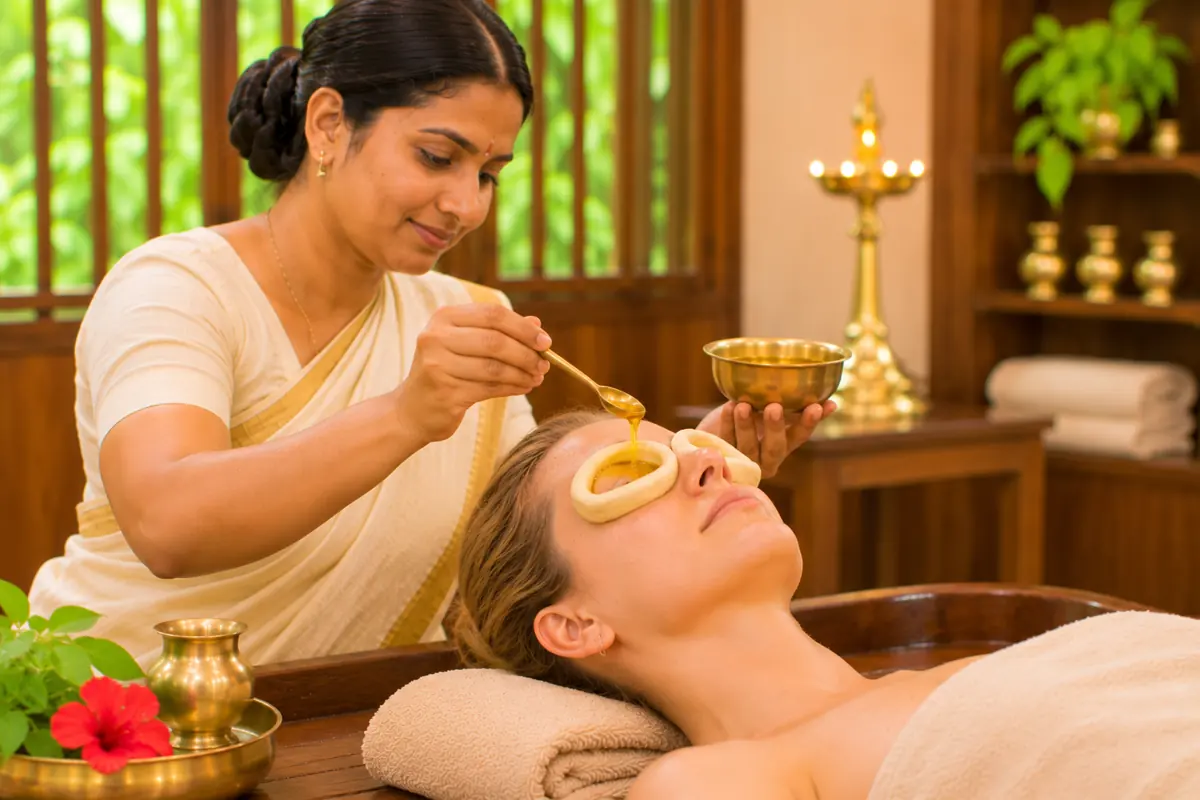
You lie on your back, your face cleansed and the area around your eyes protected. A ring of soft dough is shaped around each eye, forming a small well, and warm medicated ghee is poured in until it covers the closed eyelids. You rest, and may be asked to open and close your eyes gently in the ghee, as the therapist guides. After a short while, the ghee is drained, the dough removed, and your face wiped, followed by a period of rest.
The ghee and the dough
The physician selects a medicated ghee suited to you, which is gently warmed and checked for comfort before use. The dough, usually made from flour and water, simply holds the ghee in place. If anything feels too warm, tight or uncomfortable, please say so, and the therapist will adjust or stop at once.
What a supportive eye-comfort programme may include
- A consultation covering eye use, sleep, screens, stress and general health.
- Netra tarpana or other soothing eye therapies, as suited.
- Gentle head, face and neck massage.
- Simple eye exercises and rest breaks.
- Yoga and breathing for calm.
- Light, wholesome food and good sleep.
Who may need care
The physician may adapt or avoid netra tarpana for people with eye infections, inflammation, recent eye surgery or injury, uncontrolled eye pressure, severe colds or sinus congestion, or fever, and may take extra care with contact lens wearers. Please tell the team about anything you are unsure of.
A day at a residential centre
| Time | Typical activity |
|---|---|
| Early morning | Warm water, gentle eye exercises, breathing |
| Morning | Netra tarpana, then eye rest |
| Late morning | Quiet time, a gentle walk in natural light |
| Midday | Light, wholesome main meal and rest |
| Afternoon | Head massage or yoga |
| Evening | Light early supper, calm, early sleep |
Looking after your eyes at home
- Take screen breaks: look into the distance every twenty minutes.
- Keep screens at a comfortable distance and brightness.
- Blink often, and keep the room lit well.
- Sleep regularly, and limit screens before bed.
- Keep up with eye examinations, and share the centre's summary with your doctors.
Working alongside your own doctors
Please keep your own doctors informed. Share your medical summary, bring your reports and keep taking whatever you have been prescribed. Please keep taking prescribed medicines and eye drops, and discuss any therapy with your own doctors before you begin. Please do not change medicines without medical advice.
Choosing a centre
Look for a qualified Ayurvedic doctor (BAMS or MD Ayurveda), registered with the appropriate board, trained therapists, clean treatment rooms and a clear written plan. Be cautious of anyone who promises to cure eye conditions or to replace spectacles or eye care.
Planning the journey
Apply for your e-Medical visa on India's official portal, usually with a hospital letter, a few weeks before travel. It is valid for 60 days from first arrival, allows three entries and cannot be extended. Book flights after approval, arrange travel insurance and choose an arrival time that gives you a rested first day. Check the portal for current rules before you apply.
Your friend and hand-holder in preparing for your stay: MyVaidyam
A good plan starts with a good conversation, and that is where MyVaidyam comes in. We walk with you from your very first question to the day you return home, answering every question patiently and making sure that nothing is left to chance.
- An online consultation with an Ayurvedic physician to discuss your goals.
- Help preparing your health summary and medicine list.
- Guidance on choosing a reputable centre.
- Help understanding your written plan.
- Support with your e-Medical visa documents, flights, airport pickup and accommodation.
- A warm point of contact during your stay, and follow-up after you return home.
You are welcome to reach out at any stage. We would be delighted to help you begin.