This guide explains in plain language what shirobasti is and what to expect: why your own doctor is consulted first, how the session is done, what the oil and cap are like, how it differs from shirodhara, who may need care, how it fits into a programme, what a residential day looks like and how to carry calm home. And throughout, it shows how MyVaidyam can walk beside you as your friend and guide.
Ayurveda is offered here as a complementary, supportive approach that works alongside your own doctor's care, never as a replacement for it. It does not promise to treat any condition.
Quick Facts - Shirobasti
| Topic | Summary |
|---|---|
| What it is | Warm medicated oil held in a cap on the head |
| Session length | About 30 to 45 minutes |
| Feels like | Warmth, heaviness, quiet |
| Related therapy | Shirodhara, a continuous stream of liquid |
| Needs care in | Colds, scalp conditions, head injury, blood pressure |
| Not | A treatment for any condition |
| Visa | e-Medical visa: 60 days from first arrival, triple entry, non-extendable |
| Your companion | MyVaidyam: planning, coordination and support before, during and after |
Oil, held still
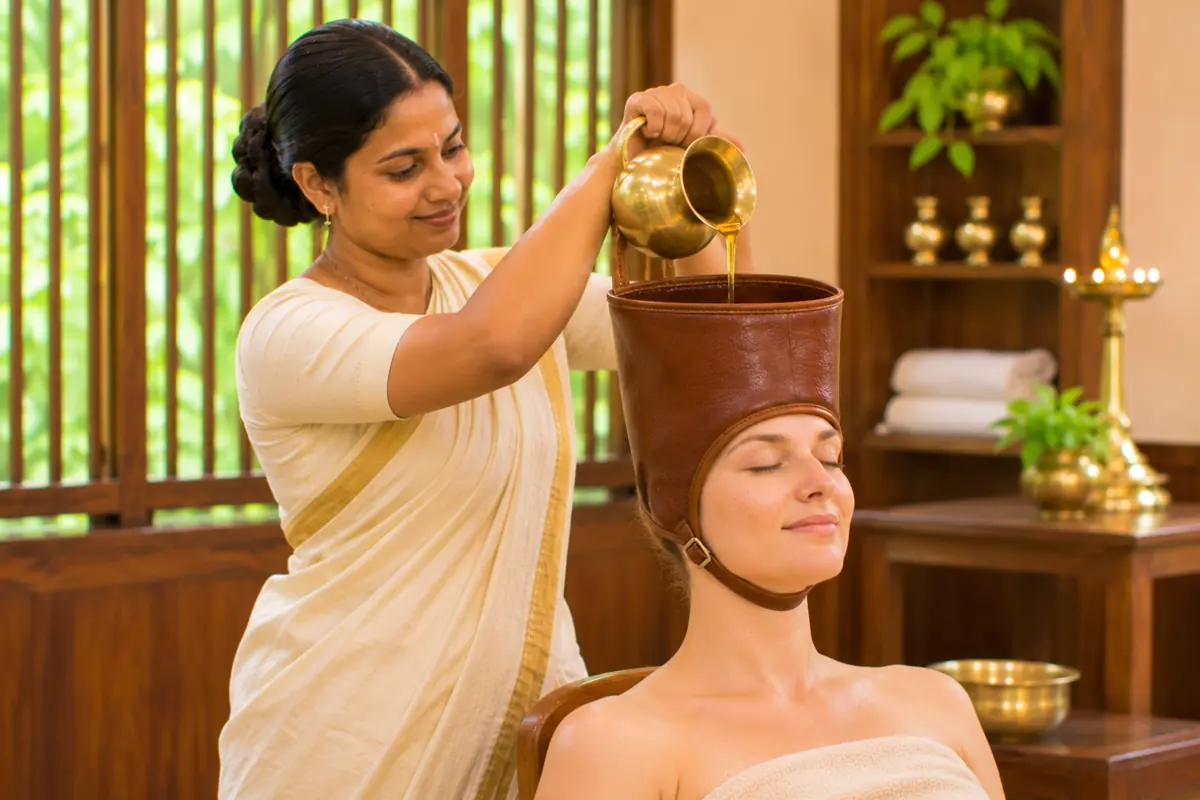
Basti, in this context, means retaining: the oil is not poured over the head but kept in a close-fitting cap, where it rests against the scalp. This stillness is the point. The warmth, the weight and the quiet combine to bring a sense of deep rest that few other therapies match.
A shirobasti session, step by step
| 1 | Settle | — seated comfortably, hair prepared, head gently massaged |
|---|---|---|
| 2 | Cap | — a snug leather or cloth cap is fitted and sealed |
| 3 | Oil | — warm medicated oil is poured to fill the cap |
| 4 | Hold | — the oil stays, the mind is still, warmth is maintained |
| 5 | Finish | — oil is drained, head wiped, then rest |
The therapy is slow and gentle, and the temperature is checked throughout.
Start with your doctor
Please discuss your plans with your own doctor, especially if you have high or low blood pressure, a history of head injury, headaches that are unusual for you, sinus or ear problems, or scalp conditions. Tell the Ayurvedic doctor about all conditions and allergies, and continue every prescribed medicine.
How Ayurveda looks at it
Ayurveda associates the head with the mind and senses, and uses oil, warmth and stillness to support calm and nourishment. Shirobasti is offered as a supportive therapy, together with sleep, food and rest, never as a cure.
How the session is done
You sit upright on a comfortable stool or chair. A leather or cloth cap, with an open top, is fitted snugly around the head and sealed at the edges, usually with a dough paste. Warm medicated oil is then poured in until it covers the scalp, and it stays for around thirty to forty-five minutes, kept warm and topped up as needed. The oil is then drained, the cap removed and the head gently wiped.
The oil and the cap
The physician selects an oil suited to you, often prepared with herbs, and its temperature is checked before it is used. The cap is made to fit, and is cleaned between guests. If it feels tight, hot or uncomfortable, please say so; the session can be adjusted or stopped at once.
Shirobasti and shirodhara
Shirodhara is a continuous, rhythmic stream of oil, milk, buttermilk or other liquid over the forehead, while shirobasti retains oil on the scalp. Many guests describe shirodhara as flowing and shirobasti as grounding. The physician chooses between them, or offers both at different times, according to your needs.
What a supportive programme may include
- A consultation covering sleep, stress, routine and health.
- Shirobasti or shirodhara, as suited.
- Gentle head, neck and body massage.
- Yoga, breathing and meditation.
- Light, wholesome food and rest.
Who may need care
The physician may adapt or avoid shirobasti for people with colds or sinus congestion, certain scalp or skin conditions, fever, very high or low blood pressure, recent head injury, and during pregnancy. Please tell the team about anything you are unsure of.
A day at a residential centre
| Time | Typical activity |
|---|---|
| Early morning | Warm water, yoga and breathing |
| Morning | Main therapy session, with rest |
| Late morning | Light activity or a walk |
| Midday | Light, wholesome main meal and rest |
| Afternoon | Relaxation, teaching or quiet time |
| Evening | Light early supper, calm, early sleep |
Taking it home
- Keep a calm evening routine and regular sleep.
- A gentle scalp massage with a light oil, if your doctor agrees.
- Practise the breathing you were taught.
- Limit screens before bed.
- Share the centre's summary with your doctor.
Setting honest expectations
Shirobasti is a supportive, relaxing therapy, and no therapy can promise to treat any condition. A residential stay offers skilled hands, rest and routine, and many guests value the stillness as much as the therapy.
Working alongside your own doctors
Please keep your own doctors informed. Share your medical summary, bring your reports and keep taking whatever you have been prescribed. Please keep taking prescribed medicines, and discuss any therapy with your own doctors before you begin. Please do not change medicines without medical advice.
Choosing a centre
Look for a qualified Ayurvedic doctor (BAMS or MD Ayurveda), registered with the appropriate board, trained therapists, clean treatment rooms and equipment, and a clear written plan. Be cautious of anyone who promises cures for sleep or mind-related conditions.
Planning the journey
Apply for your e-Medical visa on India's official portal, usually with a hospital letter, a few weeks before travel. It is valid for 60 days from first arrival, allows three entries and cannot be extended. Book flights after approval, arrange travel insurance and choose an arrival time that gives you a rested first day. Check the portal for current rules before you apply.
Your friend and hand-holder in preparing for your stay: MyVaidyam
A good plan starts with a good conversation, and that is where MyVaidyam comes in. We walk with you from your very first question to the day you return home, answering every question patiently and making sure that nothing is left to chance.
- An online consultation with an Ayurvedic physician to discuss your goals.
- Help preparing your health summary and medicine list.
- Guidance on choosing a reputable centre.
- Help understanding your written plan.
- Support with your e-Medical visa documents, flights, airport pickup and accommodation.
- A warm point of contact during your stay, and follow-up after you return home.
You are welcome to reach out at any stage. We would be delighted to help you begin.