This guide explains the Ayurvedic view, what a stay typically includes and how to plan with confidence. Ayurveda is offered as a complementary, supportive approach alongside your own doctor's care, never a replacement for it.
Quick Facts - Residential or Day Visits?
| Topic | Summary |
|---|---|
| Residential (inpatient) | You stay at the centre or its hospital; daily observation, meals and routine are arranged |
| Day visits (outpatient) | You attend sessions and stay elsewhere, for example a hotel |
| Ayush therapy centre | Defined as an outdoor care facility (Ayush minimum standards) |
| Day-care centre | Outdoor facility for conditions needing observation of less than 24 hours |
| More supervision suits | Cleansing procedures, long-term conditions with medicines, complex history |
| Day visits may suit | Simple external therapies, short or follow-up care, people close to the centre |
Understanding the question
The choice is rarely about quality and mostly about fit. A residential stay offers immersion and observation, while day visits offer flexibility. Your health, your goals and the programme your doctor proposes decide which suits you best.
What the terms mean
Residential or inpatient care means you live at the centre or its hospital, with meals, rest and observation arranged. Outpatient care means you attend for sessions and stay elsewhere. Some centres offer both.
What India's published standards say
The Ministry of Health and Family Welfare's Ayush minimum standards define a therapy centre as an outdoor care facility and a day-care centre as one for conditions needing observation for less than 24 hours. The All India Institute of Ayurveda describes separate set-ups for outpatients and inpatients, with wards near its Panchakarma theatres.
When a residential stay makes sense
A residential stay suits cleansing procedures, long-term conditions with medicines, frailty or a complex history, and guests who want a full, uninterrupted routine. Daily observation, regular meals and rest are built in.
When day visits make sense
Day visits can suit simple external therapies, short programmes, follow-up care and guests who live near the centre or prefer a hotel. You keep more independence, with less of the structure of a residential stay.
Practical differences
| Aspect | Difference |
|---|---|
| Observation | Daily, around the clock for residential; during sessions for day visits |
| Meals | Prepared for your plan for residential; your own arrangement for day visits |
| Rest | Built in for residential; your responsibility for day visits |
| Cost | Ask for itemised written quotes for each option |
Risks to think about
With day visits, plan how you will rest, eat and travel between your lodging and the centre, and who you will call if you feel unwell outside session hours. With a residential stay, plan how you will manage time away from home. Both are easily managed with a little preparation.
How to decide
- Ask your doctor which format suits your health and programme.
- Consider how much supervision you would like.
- Compare itemised quotes for the same dates.
- Think about travel time and rest between sessions.
- Ask whether you can switch if your needs change.
Questions to ask the centre
- Do you offer both formats?
- What is included in each quote?
- Where would I stay for day visits?
- What happens if I feel unwell outside sessions?
- Can I change format mid-programme?
A hybrid approach
Some guests begin with a residential stay for the main treatments and continue with day visits or online reviews for follow-up. Others start with a short residential stay to see how they feel. Ask your centre what is possible.
Keeping a simple diary
A small notebook is one of the most useful things to bring. Each evening, jot down how you feel, your sleep, your energy and anything you would like to ask. After a week or two the pattern often becomes clear, and you and the physician can fine-tune the plan. A few notes each evening help both your doctors. The same notes give your own doctor a helpful picture when you return.
Travelling comfortably
A little planning makes the journey smoother. Book an aisle seat so you can stand and stretch, keep your medicines and reports in your hand luggage, and choose a flight that arrives at a comfortable hour. Carry your medicines and a doctor's letter in your hand luggage, and keep your documents together. Ask the centre to arrange the transfer and a restful first day. Our guide to the attendant visa explains how a family member can travel with you.
Conversations to have before you travel
A short chat with your own doctor makes the stay smoother. Many guests ask:
- Are my medicines and plans up to date for the trip?
- How should I continue in the weeks after I return?
- Is there anything you would like the Ayurveda team to know?
- When would you like to see me after I return?
Sharing the answers with the Ayurveda physician helps the two teams work in step, and leaves you feeling confident and well supported.
Travelling with family or a companion
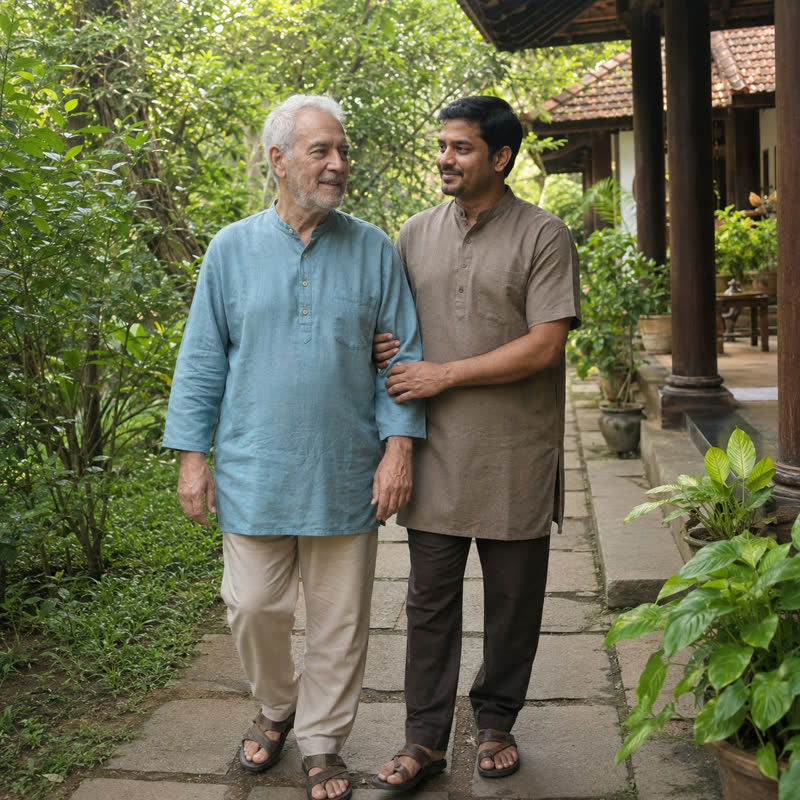
Many guests travel with a spouse, a friend or an adult child, and a companion can make the whole experience easier. Ask each centre whether companions can share your room or stay nearby, whether they can join meals, yoga and walks, and whether there is a pleasant place for them to relax while you have therapies. A companion can help with logistics, share the quiet days and keep your family informed. Our guide to the attendant visa explains the paperwork.
After you return
Many guests keep up a simple diet, an earlier bedtime and gentle daily movement for several weeks, and review their health with their own doctor. Ask the centre for a written summary of your programme, your diet and your exercises, and share it with your own doctor at your next visit. A follow-up video call with the physician a few weeks later is a good way to review how you are feeling. Our guide to continuing Ayurveda at home explains how to keep the benefits going.
Questions to ask before you book
These questions help you compare centres and plan with confidence.
- Who will be my physician, and what are their qualifications?
- Can the plan work around my usual medicines and appointments?
- Which option do you advise for me, and why?
- What does the quote include, and what is extra?
Preparing for your stay
Tell the doctor about your health, medicines and travel plans, and ask for itemised quotes for both options for the same dates.
Planning your budget
Cost depends on room, length, therapies, physician time and medicines. Ask each centre for an itemised, dated quote for the same dates and inclusions, and add visa, flights, insurance and transfers. See the cost guide and verifying a doctor.
Travelling with confidence, and how MyVaidyam can help
- Share your reports and current medicines with the Ayurveda physician before you travel.
- Continue your prescribed medicines, and let your own doctor know your plans.
- Ask for ingredient lists for any herbal medicine, and choose labelled preparations.
- Plan rest after the flight so you can begin your stay comfortably.
- Ask your doctor which format suits your health and programme best.
MyVaidyam can arrange a free online pre-consultation, have your reports reviewed by an Ayurvedic physician and request day-by-day plans and itemised quotes from centres so you can compare them calmly. Contact MyVaidyam to book your free online consultation.