This guide covers booking assistance with your airline, getting through airports, choosing accessible accommodation and questions to ask your centre.
Quick Facts - Traveling with Limited Mobility
| Topic | Summary |
|---|---|
| Notice to airline | Ideally at least 48 hours before departure |
| Assistance | From terminal to aircraft and aircraft to exit, per Indian aviation guidelines |
| Carriage | Airlines should not refuse carriage of persons with disability or reduced mobility if informed at booking |
| Medical certificate | Not normally required for those needing only boarding help and reasonable in-flight accommodation |
| Wheelchair service charges | Check the airline's current policy |
| Centres | Ask in writing about accessibility |
| Last checked | 28 October 2026; confirm with your airline |
Start with your doctors
Speak with your own doctor about your plans and ask whether they have advice on travel. Share your needs openly with the Ayurvedic doctor too, so the programme can be planned gently around your strength and mobility.
Booking and airline assistance
Tell your airline when you book that you need wheelchair or boarding assistance, and ask it to confirm in writing. Indian aviation guidelines describe assistance from the terminal to the aircraft and from the aircraft to the exit. Giving at least 48 hours' notice helps the airline arrange it smoothly. Some airlines may apply a charge for certain services, so ask when you book.
Choosing flights
Choose itineraries with comfortable layovers, ideally two to four hours, and minimal terminal changes. A single ticket with checked baggage through to the final destination reduces stress. An aisle seat with extra legroom is helpful for many people.
At the airport
- Arrive early and ask the check-in desk to confirm your assistance.
- Keep medicines, documents and a small snack in hand luggage.
- Ask for help with immigration queues if needed.
- Keep your assistance contact handy on arrival.
Choosing the right centre
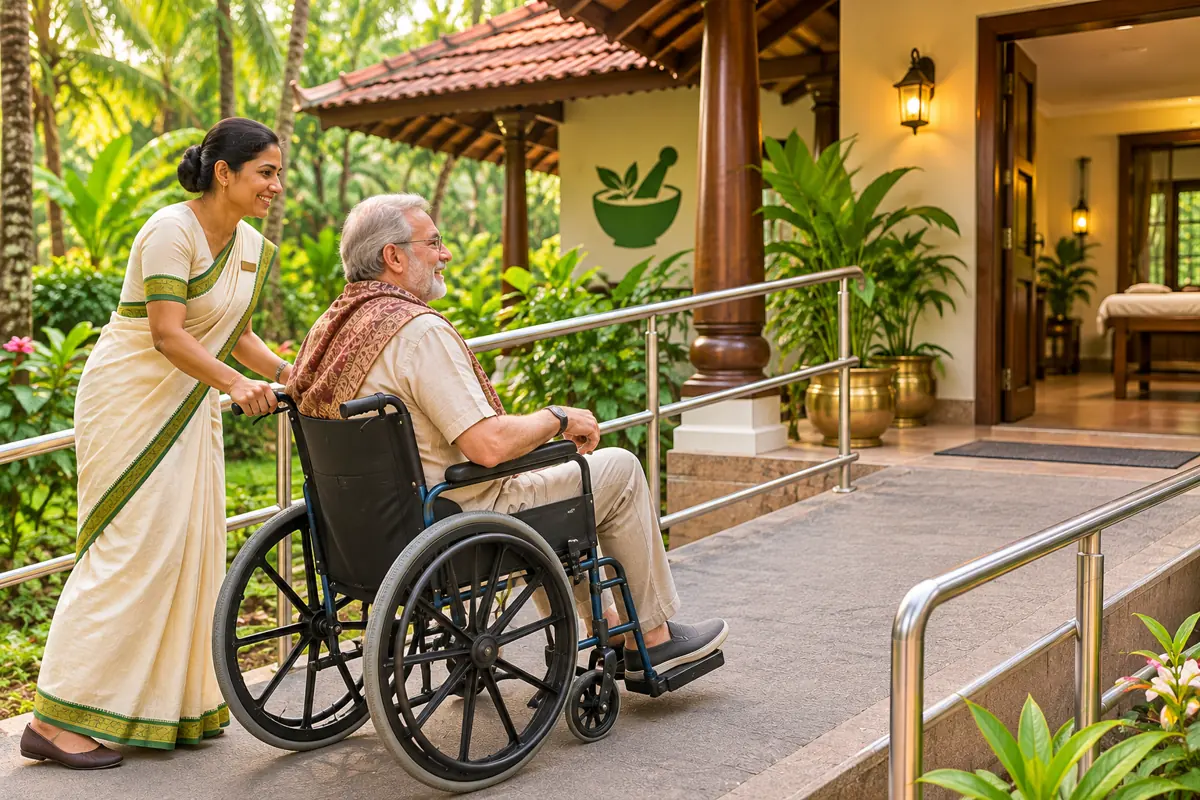
No single official accessibility standard applies, so ask each centre about their facilities in writing. Useful questions include whether rooms are on the ground floor, whether bathrooms are wheelchair-friendly, and whether treatment rooms are easy to reach.
- Ground-floor or lift-accessible rooms.
- Step-free paths to treatment rooms and dining.
- Bathrooms with grab rails and shower seats.
- Staff trained to assist with transfers.
Travelling with a companion
Hospitals in India usually ask a guardian or attendant to stay with a patient, and companions are very helpful for mobility and daily needs. A companion can apply for an attendant visa. Our attendant visa guide explains the details.
Equipment and medicines
If you use a wheelchair, walker or other equipment, check airline rules about transporting it, and ask your centre what is available locally. Keep medicines in original packaging in your hand luggage, with a list of doses.
Pacing your journey
Consider arriving a day or two earlier to rest, and building a gentle first day. Taking breaks, drinking water and moving your legs regularly during flights helps you arrive refreshed.
Travel insurance
Choose a policy that covers medical care in India and medical evacuation, and tell your insurer about your condition. Keep the emergency number saved on your phone.
Comfort on the flight
- Choose an aisle seat or one with extra legroom.
- Move your ankles and legs regularly.
- Wear loose, comfortable clothes.
- Carry a small cushion and a light blanket.
Gentle programmes
Many therapies can be adapted for reduced mobility, and your doctor will choose those that suit you. Share how you feel each day so the plan can be adjusted.
Getting around the centre
Ask staff for help with transfers and for a quiet room close to dining and treatment areas. Small adjustments make days easier.
Falls prevention and comfort
Wear non-slip footwear, keep paths clear and use handrails. Staff are glad to help when you ask.
Planning excursions
Choose short outings with a trusted driver and a vehicle that is easy to enter, and rest before and after.
Communication with family
Share your itinerary and daily updates with family at home so that everyone feels reassured.
A few words on pacing
Many guests are surprised by how much the unhurried pace helps. Treat the first few days as a time to settle in rather than to achieve anything, and let the routine of meals, rest and treatment do its quiet work.
Staying connected with home
A local SIM or an international plan makes it easy to message family and share photos. A short daily call home is often enough to keep loved ones reassured and lets you enjoy the rest of your time fully present.
Keeping a simple journal
A few lines each evening about your sleep, digestion, energy and mood help you notice changes, and they give your physician useful detail at your next review. They also make a lovely record of your stay.
Dressing for comfort
Light cotton clothing in soft colours, comfortable sandals and a thin shawl or jacket for air-conditioned rooms suit most programmes. Your centre can tell you whether treatment robes are provided.
Asking questions freely
Good care is a conversation. Ask your physician to explain each treatment, the reason for each medicine and what to expect. A caring doctor will welcome your curiosity and adjust the explanation to what is most helpful for you.
Rest is part of the treatment
Early nights, a quiet afternoon and time outdoors are not extras; they are part of the plan. Give yourself permission to rest without guilt, and let your body settle into the rhythm of the programme.
Choosing a comfortable room
When you discuss accommodation with your centre, mention any needs such as a quiet room, ground-floor access or a bathroom with a shower stool. Small details make a big difference to comfort during your stay.
Looking forward to home
Think ahead to how you will carry your routine home. Even two or three habits, such as warm morning water, a regular dinner time and a short evening walk, can keep the benefits going long after the trip.
Take your time
There is no prize for rushing. Good decisions about travel and treatment are made calmly, with the facts in front of you and your questions answered. If something feels unclear, pause and ask.
Small habits that help
Keep one folder for every document, write down your questions as they arise, and set reminders for key dates. These tiny habits turn a long to-do list into an easy routine.
Asking for things in writing
Whenever a detail matters, such as dates, inclusions or arrangements, ask for it in a short written message. It protects everyone, avoids misunderstandings and gives you a record to refer back to.
Involving your family
Share your plans with someone at home, including your itinerary and your centre's contact details. Many people find that talking the plan through with family brings both reassurance and useful questions.
How MyVaidyam can support you
MyVaidyam is happy to help you plan an accessible, comfortable journey.
- Advice on accessible accommodation and treatment rooms.
- Coordination of airport assistance and pickup.
- Guidance for companions on visas and logistics.
- A friendly point of contact before, during and after your stay.
You are welcome to reach out at any stage with questions.