This guide explains the Ayurvedic view, what a stay typically includes and how to plan with confidence. Ayurveda is offered as a complementary, supportive approach alongside your own doctor's care, never a replacement for it.
Quick Facts - Emergency Care During Your Ayurveda Stay
| Topic | Summary |
|---|---|
| Main point | Know your emergency plan before you book |
| Retreat or hospital | Many centres are not hospitals; emergency capability varies |
| Ask the centre | Doctor or nurse on site, nearest hospital, transfer arrangements, who pays |
| Emergency number | 112 is India's single emergency number |
| Insurance | Check emergency treatment, evacuation and repatriation cover |
| Families | Share your itinerary, centre contacts, medicines and insurance details |
Understanding why a plan adds confidence
Knowing exactly what would happen in an emergency is a quiet source of reassurance. Once you have the numbers saved, the plan written and your family informed, you can put the matter aside and enjoy your stay.
When is it an emergency?
Chest pain, breathlessness, fainting, confusion, heavy bleeding, signs of stroke or a severe allergic reaction call for immediate emergency care. Tell the staff and call 112 without delay. Do not wait for the programme.
Not every centre is a hospital
Many Ayurveda centres are retreats rather than hospitals, and emergency capability varies widely. Ask what is on site, such as a doctor, a nurse and basic equipment, and what is arranged with nearby hospitals.
What to ask before you book
- Is a doctor or nurse on site, and when?
- Where is the nearest hospital, and how far?
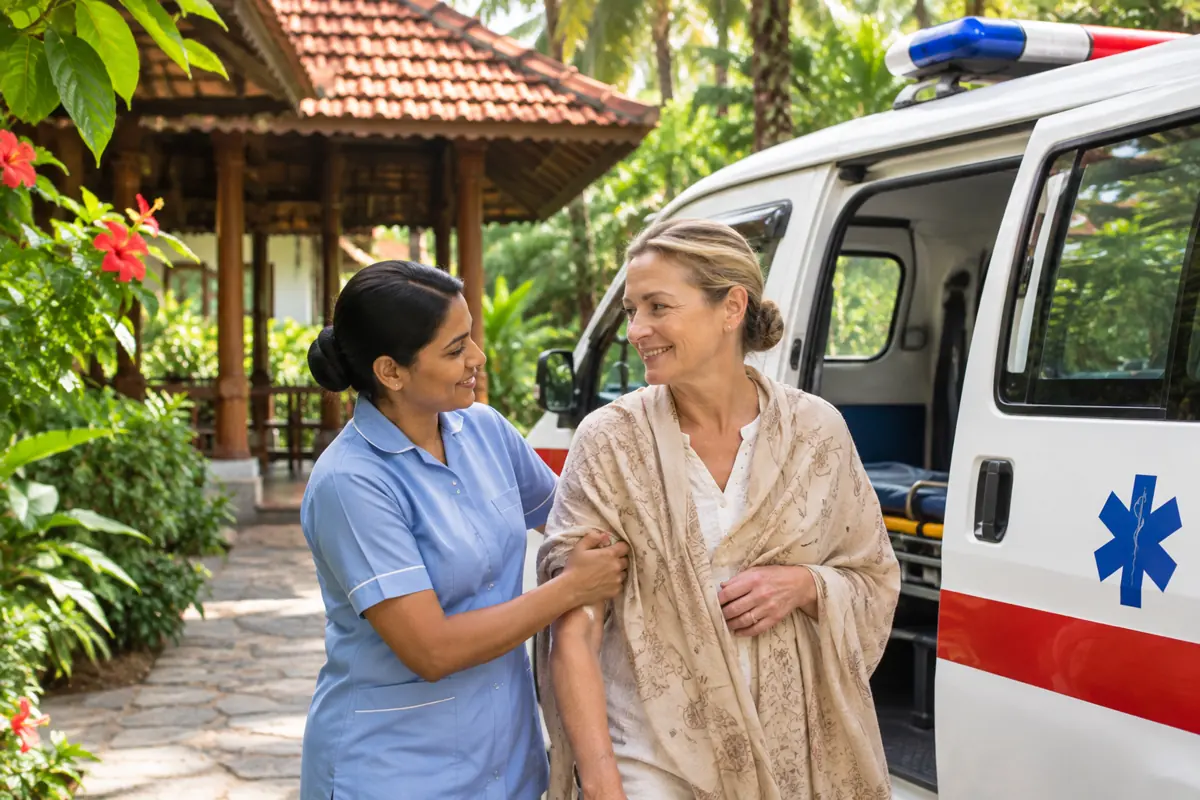
- How is an ambulance or transfer arranged?
- Who pays for emergency transfers?
- Which language will staff use with hospital teams?
Emergency numbers in India
112 is India's single emergency number, and Kerala Police operates an Emergency Response Support System on it. Confirm with your centre what it routes to locally and which ambulance number the centre prefers, and save both in your phone.
How a hospital transfer usually works
The centre's team contacts an ambulance or arranges a vehicle, accompanies you or sends a staff member, and shares your records and medicines list with the hospital. Keep your documents ready so this goes smoothly.
Insurance, evacuation and money
Check that your travel policy covers emergency treatment, evacuation and repatriation, and that wellness or medical travel is not excluded. Keep your policy number, the insurer's emergency line and a payment method with you.
What to carry and what your family should know
Carry your medicines list, allergy information, doctor's letter, insurance details and a copy of your passport. Share your itinerary, the centre's contacts and your insurance details with a family member at home.
Tell hospital doctors what you have taken
If you ever attend a hospital, show the doctors your medicines list, the Ayurvedic medicines and oils used, your allergies and the centre's discharge summary. Clear information helps them care for you quickly.
If you have a long-term condition
Carry a card listing your conditions, medicines and your specialist's contact, and agree an action plan with your specialist before you travel. Share it with the centre on arrival.
Reducing the chance of an emergency
Choose a centre with a doctor on call, share your history honestly, follow your plan, drink as advised, rest and report symptoms early. These habits keep most stays calm and uneventful.
After an emergency
Keep all records and receipts, inform your insurer, update your own doctor and ask for a written summary from the hospital. Take time to recover before resuming any programme.
Keeping a simple diary
A small notebook is one of the most useful things to bring. Each evening, jot down how you feel, your sleep, your energy and anything you would like to ask. After a week or two the pattern often becomes clear, and you and the physician can fine-tune the plan. A few notes each evening help both your doctors. The same notes give your own doctor a helpful picture when you return.
Travelling comfortably
A little planning makes the journey smoother. Book an aisle seat so you can stand and stretch, keep your medicines and reports in your hand luggage, and choose a flight that arrives at a comfortable hour. Carry your medicines and a doctor's letter in your hand luggage, and keep your documents together. Ask the centre to arrange the transfer and a restful first day. Our guide to the attendant visa explains how a family member can travel with you.
Conversations to have before you travel
A short chat with your own doctor makes the stay smoother. Many guests ask:
- Are my medicines and plans up to date for the trip?
- How should I continue in the weeks after I return?
- Is there anything you would like the Ayurveda team to know?
- When would you like to see me after I return?
Sharing the answers with the Ayurveda physician helps the two teams work in step, and leaves you feeling confident and well supported.
Travelling with family or a companion
Many guests travel with a spouse, a friend or an adult child, and a companion can make the whole experience easier. Ask each centre whether companions can share your room or stay nearby, whether they can join meals, yoga and walks, and whether there is a pleasant place for them to relax while you have therapies. A companion can help with logistics, share the quiet days and keep your family informed. Our guide to the attendant visa explains the paperwork.
After you return
Many guests keep up a simple diet, an earlier bedtime and gentle daily movement for several weeks, and review their health with their own doctor. Ask the centre for a written summary of your programme, your diet and your exercises, and share it with your own doctor at your next visit. A follow-up video call with the physician a few weeks later is a good way to review how you are feeling. Our guide to continuing Ayurveda at home explains how to keep the benefits going.
Common questions
Do I keep my medicines? Yes, unless your own doctor advises otherwise. Can I ask for a written plan? Yes, and you should. Can a companion join me? Many centres allow it. How long should I stay? Your physician advises after a consultation.
Choosing a centre
Rather than looking for a ranking, compare what matters to you: a qualified Ayurveda physician, a clear assessment, a written day-by-day plan, hygiene standards, accessible rooms and good access to a hospital. Ask each centre the same questions:
- Who will be my physician, and what are their qualifications?
- Which parts of my plan have I discussed with my own doctor?
- How will you coordinate with my home doctor?
- How are herbal medicines sourced, and can I see the ingredient list?
- What does the quote include, and what is extra?
Communication and language
Ask which languages the staff speak, whether someone can accompany you to hospital to help translate, and how updates will be shared with your family. A simple card in English and your own language, listing your conditions and medicines, helps at any hospital.
Mobile phones and contacts
Save the centre's reception, the doctor on call, 112, your insurer's emergency line and a family contact in your phone, and share your live location with a family member if you wish. Keep your phone charged and a paper copy of the numbers in your bag.
Practising your plan
Before you travel, rehearse your plan with your companion: who will call 112, who will speak to the hospital, where the documents are kept and how the family will be told. A five-minute rehearsal builds calm confidence and costs nothing.
A calm mindset
Emergencies are rare, and a clear plan is simply sensible preparation. With the numbers saved, documents together and family informed, most guests relax and enjoy their stay without giving the plan a second thought.
Questions to rehearse with your companion
- Who calls 112 and who calls the centre?
- Where are the medicines list and insurance papers?
- Who speaks to the hospital?
- Who informs the family?
Preparing for your stay
Save 112 and the centre's emergency numbers in your phone, and keep your documents together in your hand luggage.
Planning your budget
Cost depends on room, length, therapies, physician time and medicines. Ask each centre for an itemised, dated quote for the same dates and inclusions, and add visa, flights, insurance and transfers. See the cost guide and verifying a doctor.
Travelling with confidence, and how MyVaidyam can help
- Share your reports and current medicines with the Ayurveda physician before you travel.
- Continue your prescribed medicines, and let your own doctor know your plans.
- Ask for ingredient lists for any herbal medicine, and choose labelled preparations.
- Plan rest after the flight so you can begin your stay comfortably.
- Share your itinerary and emergency contacts with a family member at home.
MyVaidyam can arrange a free online pre-consultation, have your reports reviewed by an Ayurvedic physician and request day-by-day plans and itemised quotes from centres so you can compare them calmly. Contact MyVaidyam to book your free online consultation.