This guide explains the Ayurvedic view, what a stay typically includes and how to plan with confidence. Ayurveda is offered as a complementary, supportive approach alongside your own doctor's care, never a replacement for it.
Quick Facts - Is Ayurveda Scientifically Proven?
| Topic | Summary |
|---|---|
| Short answer | For most conditions Ayurveda is not proven to conventional standards; the evidence is limited and mixed |
| What exists | Some trials and reviews, most small; a few early signals, for example in knee osteoarthritis |
| Why hard to test | Individualised multi-part programmes, difficulty with blinding and variable products |
| Quality | A 2004 US study of products found about one in five contained lead, mercury or arsenic |
| Strongest support | Exercise, diet, sleep and stress management, which are part of many programmes |
| Decide with | Your own doctor, who knows your history |
Understanding the middle path
The honest middle path is neither dismissing Ayurveda nor overselling it. It recognises that a centuries-old system has useful practices, that research is still developing and that good decisions combine tradition, evidence and your own doctor's advice.
What scientifically proven means
In conventional medicine a treatment is considered well supported when it has been tested in well-designed studies with a control group, random allocation, enough participants and results that hold up when repeated. Few Ayurvedic programmes have been tested to this standard, and we say so plainly.
Why Ayurveda is hard to test
Ayurvedic programmes are individualised and made of many parts: massage, medicines, food, yoga and routine. Blinding is difficult, products and practice vary, and a trial of one programme does not apply to another. These challenges slow research and make careful interpretation essential.
A worked example: knee osteoarthritis
A 2018 randomised trial of an Ayurveda treatment approach in knee osteoarthritis, and a 2015 systematic review and meta-analysis of Ayurvedic interventions for osteoarthritis by Kessler and colleagues, give some of the clearest early signals, alongside cautions about study quality. They illustrate both the promise and the limits of the evidence.
Where the support is strongest
The elements with the strongest evidence in general medicine, regular exercise, good nutrition, sleep and stress management, are also central to a residential stay. Many guests benefit from these alone, and a good centre helps you carry them home.
Quality of products
A 2004 JAMA study tested 70 Ayurvedic herbal products bought near Boston and found that 14, or 20 per cent, contained lead, mercury or arsenic. This is a reason to choose reputable manufacturers, ask for ingredient lists and batch details, and tell your doctors what you take.
How to read claims critically
- Ask for the source behind any scientifically proven claim.
- Look for study size, controls and follow-up.
- Be cautious about promises of cure.
- Never stop prescribed medicines on a claim.
- Discuss any claim with your own doctor.
What we have not reviewed
We have not reviewed trials for every Ayurvedic therapy and condition, and we do not claim more than the evidence allows. Where a guide says that research is limited, that is exactly what we mean.
The role of standards and regulation
WHO benchmarks for the practice of Ayurveda, India's registration of practitioners and manufacturing standards for medicines all contribute to quality, and they continue to develop. Ask any centre which standards it follows.
What this means for your decision
If you value rest, routine, warmth and nourishing food, a stay can be a worthwhile investment in wellbeing. If you hope for a cure of a serious condition, speak to your specialist first. Honest expectations lead to the most satisfying stays.
Questions to take to your own doctor
- Is a residential programme suitable for me?
- What should I watch for?
- Which tests should I repeat after my stay?
- How can I continue the good habits at home?
Keeping a simple diary
A small notebook is one of the most useful things to bring. Each evening, jot down how you feel, your sleep, your energy and anything you would like to ask. After a week or two the pattern often becomes clear, and you and the physician can fine-tune the plan. A few notes each evening help both your doctors. The same notes give your own doctor a helpful picture when you return.
Travelling comfortably
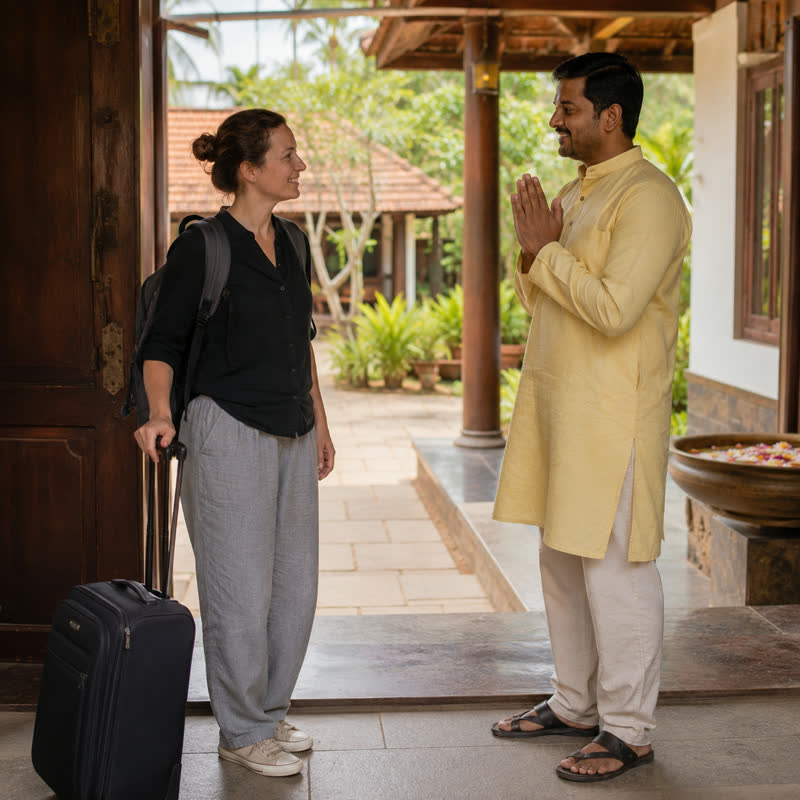
A little planning makes the journey smoother. Book an aisle seat so you can stand and stretch, keep your medicines and reports in your hand luggage, and choose a flight that arrives at a comfortable hour. Carry your medicines and a doctor's letter in your hand luggage, and keep your documents together. Ask the centre to arrange the transfer and a restful first day. Our guide to the attendant visa explains how a family member can travel with you.
Conversations to have before you travel
A short chat with your own doctor makes the stay smoother. Many guests ask:
- Are my medicines and plans up to date for the trip?
- How should I continue in the weeks after I return?
- Is there anything you would like the Ayurveda team to know?
- When would you like to see me after I return?
Sharing the answers with the Ayurveda physician helps the two teams work in step, and leaves you feeling confident and well supported.
Travelling with family or a companion
Many guests travel with a spouse, a friend or an adult child, and a companion can make the whole experience easier. Ask each centre whether companions can share your room or stay nearby, whether they can join meals, yoga and walks, and whether there is a pleasant place for them to relax while you have therapies. A companion can help with logistics, share the quiet days and keep your family informed. Our guide to the attendant visa explains the paperwork.
After you return
Many guests keep up a simple diet, an earlier bedtime and gentle daily movement for several weeks, and review their health with their own doctor. Ask the centre for a written summary of your programme, your diet and your exercises, and share it with your own doctor at your next visit. A follow-up video call with the physician a few weeks later is a good way to review how you are feeling. Our guide to continuing Ayurveda at home explains how to keep the benefits going.
Common questions
Do I keep my medicines? Yes, unless your own doctor advises otherwise. Can I ask for a written plan? Yes, and you should. Can a companion join me? Many centres allow it. How long should I stay? Your physician advises after a consultation.
Choosing a centre
Rather than looking for a ranking, compare what matters to you: a qualified Ayurveda physician, a clear assessment, a written day-by-day plan, hygiene standards, accessible rooms and good access to a hospital. Ask each centre the same questions:
- Who will be my physician, and what are their qualifications?
- Which parts of my plan have I discussed with my own doctor?
- How will you coordinate with my home doctor?
- How are herbal medicines sourced, and can I see the ingredient list?
- What does the quote include, and what is extra?
Lifestyle elements that matter
Regular meals, plenty of vegetables, daily walking, good sleep, time away from stress and social connection all support health, and each features in a well-designed stay. These are the elements most likely to help you after you go home, which is why we encourage you to focus on the routines you will keep.
Reading a study
When you meet a headline about a trial, ask how many people took part, whether there was a comparison group, how long they were followed, who funded the study and whether the result was repeated elsewhere. Your own doctor can help you weigh it, and a short chat often clears up confusion.
Preparing for your stay
Bring your reports and questions, and decide together with your own doctor. Choose a centre that speaks honestly about evidence.
Planning your budget
Cost depends on room, length, therapies, physician time and medicines. Ask each centre for an itemised, dated quote for the same dates and inclusions, and add visa, flights, insurance and transfers. See the cost guide and verifying a doctor.
Travelling with confidence, and how MyVaidyam can help
- Share your reports and current medicines with the Ayurveda physician before you travel.
- Continue your prescribed medicines, and let your own doctor know your plans.
- Ask for ingredient lists for any herbal medicine, and choose labelled preparations.
- Plan rest after the flight so you can begin your stay comfortably.
- Discuss the evidence with your own doctor, who knows your history.
MyVaidyam can arrange a free online pre-consultation, have your reports reviewed by an Ayurvedic physician and request day-by-day plans and itemised quotes from centres so you can compare them calmly. Contact MyVaidyam to book your free online consultation.
Frequently Asked Questions - Is Ayurveda Scientifically Proven?
References
- PubMed. Effectiveness of an Ayurveda treatment approach in knee osteoarthritis: a randomized controlled trial (2018)
- University of Technology Sydney repository. Kessler CS, Pinders L, Michalsen A, Cramer H. Ayurvedic interventions for osteoarthritis: a systematic review and meta-analysis. Rheumatology International, 2015;35(2):211-232
- CDC Stacks (JAMA 2004;292(23):2868-2873). Heavy metal content of Ayurvedic herbal medicine products
- NCCIH, US National Institutes of Health. Ayurvedic medicine: in depth
- World Health Organization. WHO benchmarks for the practice of Ayurveda