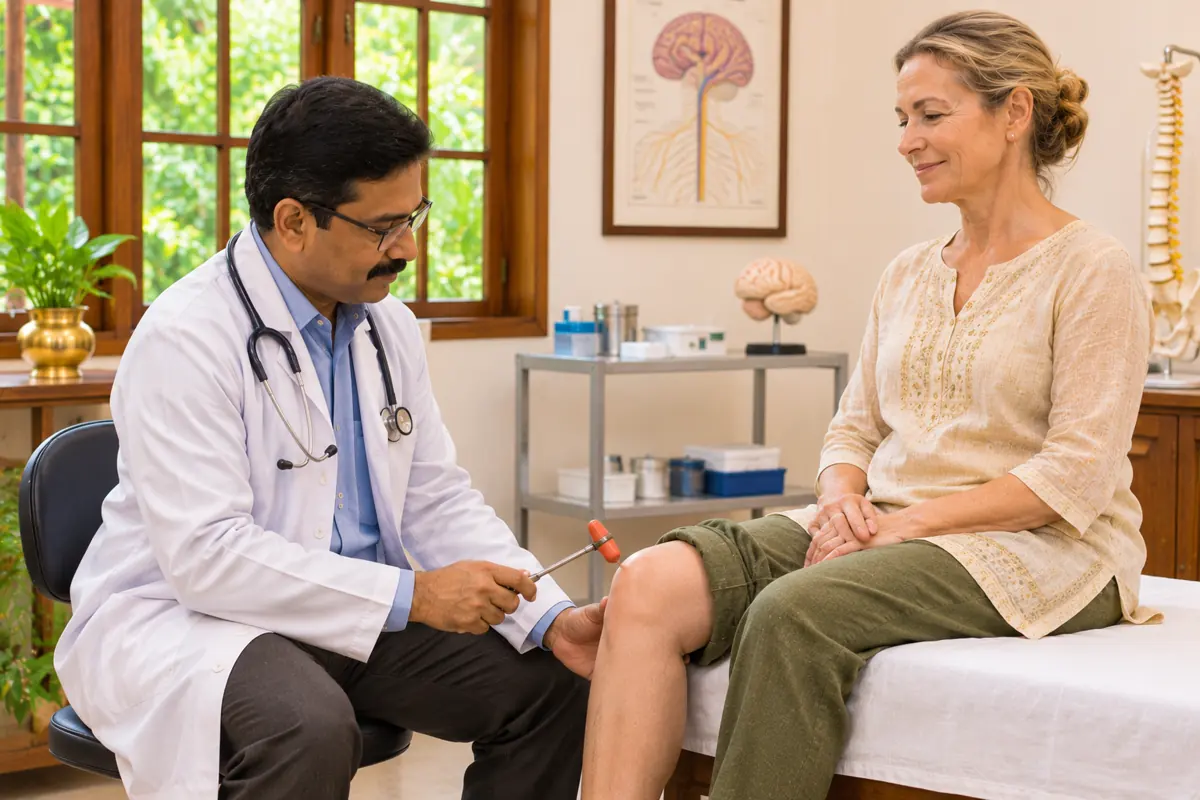
The aim is not to find reasons to stay at home, but to make sure you travel at the right time, with the right support.
This guide explains in calm, practical terms the medical points to settle with your neurologist before you travel: what "red flags" mean in this context, the situations that call for a doctor's review first, how to prepare for the flight, what to carry, how the centre can plan around your needs and when to wait. And throughout, it shows how MyVaidyam can walk beside you as your friend and guide.
Ayurveda is offered here as a complementary, supportive approach that works alongside your own doctor's care, never as a replacement for it. Your neurologist decides whether and when you travel.
Quick Facts - Medical Red Flags Before Travelling for Neurological Rehabilitation
| Topic | Summary |
|---|---|
| Purpose | To travel at the right time, with the right support |
| Step one | Your neurologist's view on fitness to travel |
| Carry | Records, medicines, letters, contact details |
| Companion | Strongly recommended |
| Centre | Should plan around your needs and have hospital backup |
| Not | A substitute for your neurologist's advice |
| Visa | e-Medical visa: 60 days from first arrival, triple entry, non-extendable |
| Your companion | MyVaidyam: planning, coordination and support before, during and after |
What we mean by a "red flag"
A red flag is simply a sign that something deserves a doctor's attention before you go ahead. It is not a reason for alarm. In neurological rehabilitation, such signs are usually matters of timing and safety: a condition that is still changing, a medical issue not yet settled or a risk that needs a plan.
A pre-travel conversation, in six checks
✓ Fitness to fly
Is air travel suitable now, and with what precautions?
✓ Stability
Is the condition stable, and what changes should prompt a call?
✓ Medicines
What to continue, carry and time-zone adjust?
✓ Seizures, swallowing, falls
Any special risks needing planning?
✓ Care on the way
Who helps with transfers and daily needs?
✓ Local backup
Which hospital and which doctor if help is needed?
These questions can be taken to your neurologist or treating team, and the answers shared with the centre.
Situations that call for a doctor's review first
Please speak to your doctor before planning if any of the following applies: a recent stroke, seizure, brain or spine injury or operation, a condition that has changed recently, new or worsening weakness, numbness, confusion or speech difficulty, difficulty swallowing, frequent falls, repeated chest infections, uncontrolled blood pressure or blood sugar, a recent change in medicines, or any recent hospital stay. In each case your doctor will say whether to wait, travel with precautions or go ahead.
Fitness to fly
Your neurologist can say whether air travel is suitable and when. Factors include how stable you are, your blood pressure, any risk of clots after immobility, seizure control, and whether oxygen, a wheelchair or a medical escort is needed. Your doctor can write a letter confirming fitness for the journey.
Medicines on the journey
- Carry all medicines in hand luggage, in original packaging.
- Bring a printed list with generic names and doses.
- Ask your doctor how to time doses across time zones.
- Carry a doctor's letter describing your condition and medicines.
- Pack extra supply in case of delay.
- Do not change or stop medicines without medical advice.
Seizure, swallowing and fall risks
If you have had seizures, ask your doctor about travel precautions, tiredness and sleep during the journey. If you have difficulty swallowing, ask a speech therapist about safe food and drink on the way and whether any special arrangements are needed. If you are prone to falls, ask about assistance at the airport, seating and the layout of your accommodation. The centre can then prepare.
Travelling with a companion
A companion is strongly recommended for anyone recovering from a neurological condition. They help with transfers, medicines, meals and communication, and they know you best. A medical attendant visa is typically used for the companion alongside the patient's e-Medical visa. Planning for two, including a room with space and safety features, is part of the preparation.
What the centre can plan around
When you share your medical summary, a good centre can arrange a room close to facilities, grab rails, a suitable bed, a diet that suits your swallowing, trained therapists and nurses, and a daily rhythm that respects your energy.
When it may be wiser to wait
There are times when waiting a few weeks is the kinder course: soon after a major event, while a medicine is being adjusted or while an issue is being investigated. Your doctor will tell you. The centre will be glad to welcome you when the time is right.
Setting honest expectations
Rehabilitation is gradual, and a residential programme offers structure, practice, rest and encouragement. It cannot promise a particular outcome, and a thoughtful team will say so. Good preparation makes it more likely that you can make the most of your time.
Working alongside your own doctors
Please keep your own doctors informed. Share your medical summary, bring your reports and keep taking whatever you have been prescribed. Please keep your own doctors informed, and continue prescribed medicines as advised. Please do not change medicines without medical advice.
Choosing a centre
Look for a qualified Ayurvedic doctor (BAMS or MD Ayurveda), registered with the appropriate board, experience with neurological guests, trained physiotherapists, nursing support, accessibility and a hospital nearby. Be cautious of anyone who promises recovery or who does not ask about your medical history.
Planning the journey
Apply for your e-Medical visa on India's official portal, usually with a hospital letter, a few weeks before travel. It is valid for 60 days from first arrival, allows three entries and cannot be extended. Book flights after approval, arrange travel insurance and choose an arrival time that gives you a rested first day. Check the portal for current rules before you apply.
Your friend and hand-holder in planning a safe journey: MyVaidyam
A careful start makes everything easier, and that is where MyVaidyam comes in. We walk with you from your very first question to the day you return home, answering every question patiently and making sure that nothing is left to chance.
- An online consultation with an Ayurvedic physician, with your neurologist's advice in hand.
- Help preparing your medical summary, medicine list and questions for your doctor.
- Guidance on choosing a reputable, accessible centre with hospital backup.
- Help planning comfortable travel for you and your companion.
- Support with your e-Medical visa documents, flights, airport pickup and accommodation.
- A warm point of contact during your stay, and follow-up after you return home.
You are welcome to reach out at any stage. We would be delighted to help you begin.