Families naturally look for every kind of gentle support, and some Ayurvedic centres offer calm, supportive care that can sit quietly alongside the specialist work.
This guide explains how supportive Ayurvedic care may be offered alongside specialist care, why swallowing safety must always come first, what a calm daily routine can contribute, what to ask a centre, how to plan travel with a companion and how to continue at home. It is supportive only, and it does not promise improvement in speech or swallowing. And throughout, it shows how MyVaidyam can walk beside you as your friend and guide.
Ayurveda is offered here as a complementary, supportive approach that works alongside your own doctor's care, never as a replacement for it. It does not replace the care of your speech-language therapist, neurologist or any other specialist.
Quick Facts - Ayurveda Support for Post-Stroke Speech and Swallowing Rehabilitation Alongside Specialist Care for International Patients
| Topic | Summary |
|---|---|
| Role | Supportive care alongside specialist care |
| Led by | Speech-language therapist and neurologist |
| First priority | Swallowing safety and prescribed diet textures |
| Ayurvedic support | Calm routine, gentle relaxation, adapted diet |
| Travel | After clearance, with a companion |
| Not | A promise of improved speech or swallowing |
| Visa | e-Medical visa: 60 days from first arrival, triple entry, non-extendable |
| Your companion | MyVaidyam: planning, coordination and support before, during and after |
Starting with your specialists
Speech and swallowing after a stroke are assessed and treated by trained specialists. A speech-language therapist works on communication and on safe swallowing, a neurologist guides medical care, and a dietitian may advise on textures and nutrition. Before planning any residential programme, talk with them about whether and when travel is appropriate, what must continue during your stay and what should be avoided. Their advice is the foundation of everything else.
Specialist care at the centre of the circle
Speech-language therapist
Assessment and therapy for speech, voice and swallowing
Neurologist and your doctors
Diagnosis, medicines and medical advice
Ayurvedic physician
Supportive routine, diet and gentle therapies, within specialist advice
Family and companion
Encouragement and practical help
Everyone in the circle shares one aim: your comfort, safety and wellbeing.
Swallowing safety comes first
Swallowing difficulty needs particular care, because food or drink entering the airway can cause problems. Your specialists may have prescribed a particular texture of food and thickness of fluids, along with positioning and feeding techniques. These instructions must be followed exactly, at the centre as at home. Share them in writing with the centre in advance, and ask whether the kitchen can prepare food to those specifications reliably before you decide to go.
What Ayurvedic support may offer
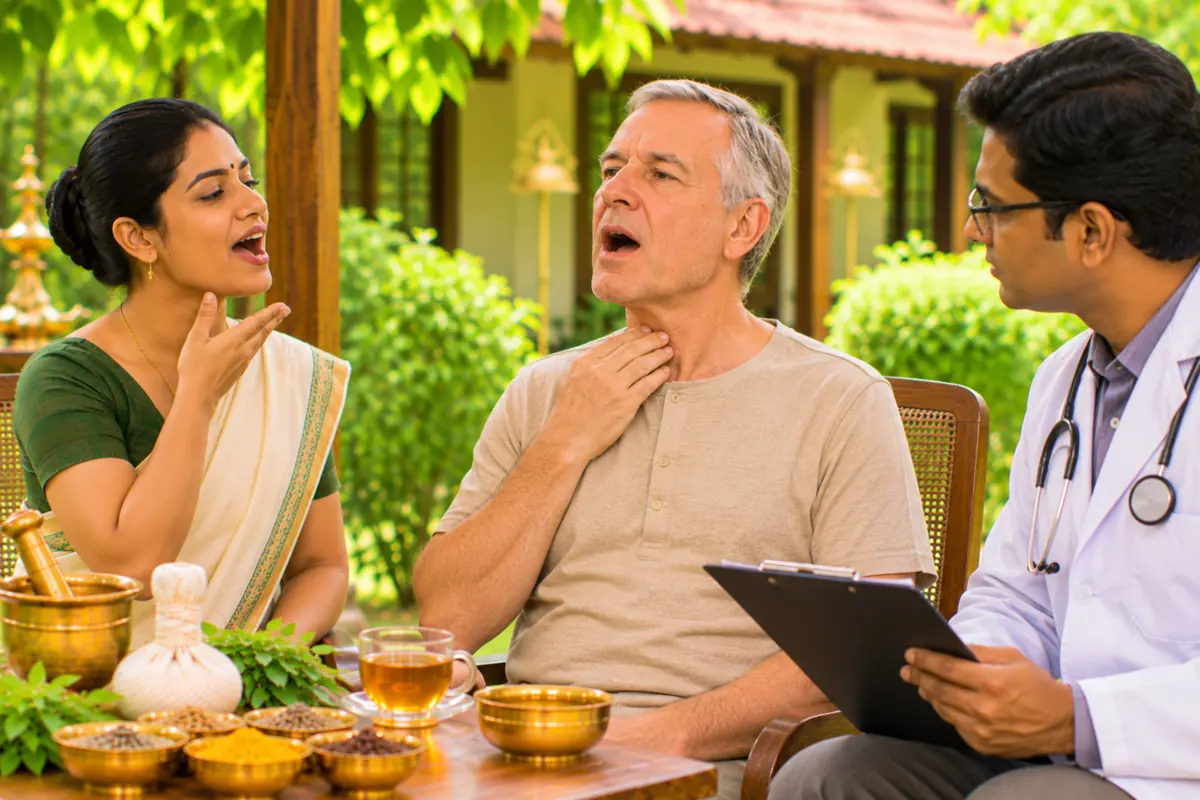
Within those limits, supportive Ayurvedic care focuses on the whole person: a calm, predictable daily routine, rest, gentle warm therapies for the body, relaxation and breathing practices, and a simple, nourishing diet adapted to your specialists' advice. Many guests and families describe the quiet setting and unhurried pace as a comfort. Nothing is intended to replace the exercises, techniques or therapy sessions that your speech-language therapist has set.
Speech and communication practice
Speech practice is best led by a speech-language therapist. If the centre does not have one, ask whether your own therapist's exercises can continue, perhaps with the help of your companion, and whether online sessions with your therapist at home are possible. A calm, patient environment, free from pressure, helps communication feel easier. Family members can help by giving time, listening and encouraging without finishing sentences.
Diet at a residential centre
Meals at residential centres are usually vegetarian, freshly cooked and gentle on digestion, which can suit some modified diets. But texture, thickness and safety come first, and the kitchen must be able to follow your specialists' instructions. Ask whether they can prepare softened, minced, pureed or thickened options as required, and how mealtimes are supervised. A companion can sit with you at each meal.
Who this may suit
Supportive programmes tend to suit people who are medically stable, have a clear, written plan from their specialists, can travel safely and are accompanied by a family member or helper trained in their feeding and communication techniques. They are less suited to anyone who needs close medical or swallowing monitoring, or whose specialists advise staying near their rehabilitation team. A frank conversation with your own doctors and the centre's physician is the way to decide.
The role of a companion
A companion is essential in this situation. They can help with meals and positioning, support communication, take part in discussions with the physician and keep the specialists' instructions at hand. Ask whether the centre welcomes companions, and what arrangements exist for them to stay and eat. A medical attendant visa is typically used for the companion alongside the patient's e-Medical visa.
Travelling with care
Plan the journey around comfort and safety: direct flights where possible, airport assistance, time to rest on arrival and a plan for meals and drinks in transit. Carry any thickener, feeding equipment and medicines, with letters from your specialists. Keep your specialists' contact details handy, and agree beforehand how you will reach them if a question arises.
Questions to ask the centre
- Have you supported guests after stroke with swallowing difficulty?
- Can the kitchen prepare my prescribed textures and thickened fluids reliably?
- How will my speech-language therapist's programme be followed?
- What happens if there is a swallowing concern during a meal?
- How close is a hospital, and how are emergencies handled?
- Can my companion stay and join the consultations?
Mind, mood and encouragement
Difficulty speaking can be isolating and frustrating, for the person and for those who love them. A calm setting, patient company and a gentle rhythm of days can lift spirits. Breathing and relaxation practices are often included in supportive programmes. If low mood or anxiety is a concern, share it with your own doctors and the physician.
Continuing at home
- Keep up your speech-language therapist's exercises and follow-up.
- Continue the diet textures your specialists have advised.
- Keep a regular, calm routine.
- Give plenty of time and patience for communication.
- Share the centre's summary with your own team.
Planning around your visa
The e-Medical visa is valid for 60 days from first arrival, with triple entry and no extension. Plan dates with your physician and your specialists, and leave spare days at the end for rest before your flight home.
Setting honest expectations
Recovery of speech and swallowing is gradual and individual, and no programme can promise a particular result. A residential stay can offer comfort, routine and encouragement alongside the specialist work you are already doing. Talking about this honestly before you travel helps everyone feel at ease.
Working alongside your own doctors
Please keep your own doctors informed. Share your medical summary, bring your reports and keep taking whatever you have been prescribed. Please keep taking all prescribed medicines and continue the advice of your neurologist, speech-language therapist and other specialists. Please do not change medicines without medical advice.
Choosing a centre with experience
Look for a qualified Ayurvedic doctor (BAMS or MD Ayurveda), registered with the appropriate board, experience with neurological conditions, a kitchen able to follow modified diets, accessible facilities, medical backup nearby and a willingness to work within your specialists' advice. Be cautious of anyone who promises improved speech or swallowing, who suggests changing prescribed textures or who suggests stopping medical treatment.
Planning the journey
Apply for your e-Medical visa on India's official portal, usually with a hospital letter, a few weeks before travel. It is valid for 60 days from first arrival, allows three entries and cannot be extended. Book flights after approval, arrange travel insurance and choose an arrival time that gives you a rested first day. Check the portal for current rules before you apply.
Your friend and hand-holder through the whole journey: MyVaidyam
A journey like this is best taken with a friend beside you, and that is where MyVaidyam comes in. We walk with you from your very first question to the day you return home, answering every question patiently and making sure that nothing is left to chance.
- An online consultation with an Ayurvedic physician to discuss your needs with your family.
- Help preparing your health summary, specialists' letters and written diet instructions.
- Guidance on choosing a reputable, accessible centre able to follow them.
- Help planning comfortable travel for you and a companion.
- Support with your e-Medical visa documents (including for a companion), flights, airport pickup and accommodation.
- A warm point of contact during your stay, and follow-up after you return home.
You are welcome to reach out at any stage. We would be delighted to help you begin.