Some Ayurvedic centres offer gentle, supportive care that can sit alongside this work.
This guide explains what upper-limb stiffness after a stroke means in plain terms, how supportive Ayurvedic care may be offered, how it works with rehabilitation, what to ask a centre and how to plan safely with a companion. It is supportive only, and it does not promise to restore movement. And throughout, it shows how MyVaidyam can walk beside you as your friend and guide.
Ayurveda is offered here as a complementary, supportive approach that works alongside your own doctor's care, never as a replacement for it. It does not replace the care of your neurologist and rehabilitation team.
Quick Facts - Ayurveda Support for Post-Stroke Upper-Limb Stiffness for International Patients
| Topic | Summary |
|---|---|
| Role | Supportive care alongside rehabilitation |
| Central | Stretching, positioning, task-based practice |
| Ayurvedic support | Gentle warm therapies, diet, calm routine |
| Led by | Your neurologist and rehabilitation team |
| Travel | After clearance, with a companion |
| Not | A promise of restored movement |
| Visa | e-Medical visa: 60 days from first arrival, triple entry, non-extendable |
| Your companion | MyVaidyam: planning, coordination and support before, during and after |
Understanding stiffness after a stroke
After a stroke, muscles on the affected side may become tight or stiff, sometimes called spasticity, and the shoulder, elbow, wrist and fingers can feel hard to move. This is common, and it is something rehabilitation teams manage every day, with stretching, positioning, splints, exercises and, where appropriate, medicines or other treatments. Your own doctors and therapists know your situation best.
Following the arm, shoulder to fingers
| Shoulder | — relaxing tight muscles before movement |
|---|---|
| Elbow | — gentle range-of-motion practice |
| Wrist | — supported positioning, light stretching |
| Hand and fingers | — guided, task-based exercises |
The picture shows where gentle support is commonly focused. Your therapist will tell you how to move each area safely.
Where Ayurveda may fit
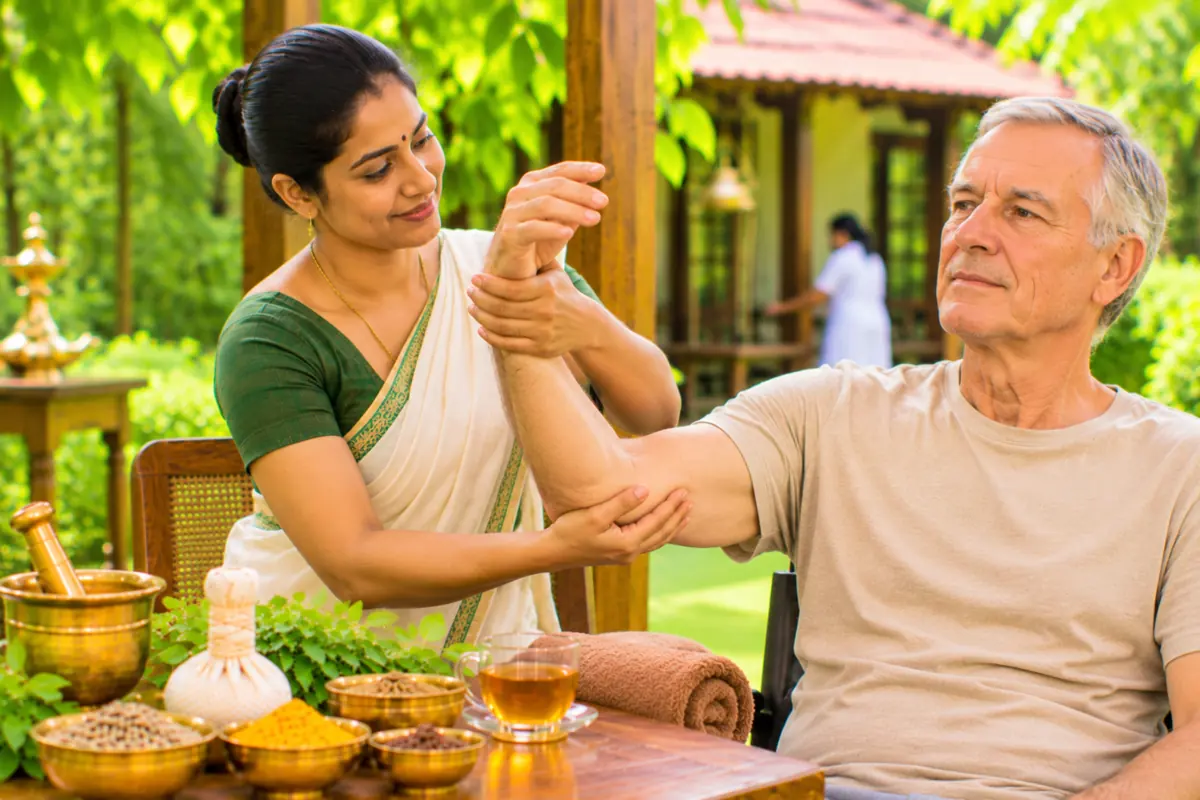
Ayurvedic centres experienced in neurological care may offer warm herbal oil massage, gentle warmth and steam, a nourishing simple diet and a calm daily rhythm. Traditionally these are described as soothing, and many guests find them relaxing, which can make it easier to move afterwards. They are offered as supportive care, and they never replace the stretching and practice that your therapists recommend.
Working with rehabilitation
The most helpful arrangement is one where gentle warmth and massage are followed by guided movement. If the centre has a physiotherapist or occupational therapist, ask how upper-limb practice is included. If not, ask whether your own therapist's exercises can continue and how they will be supervised. Share your therapist's written programme with the centre before you arrive.
Safety in handling a stiff or weak arm
A stiff or weak arm needs careful handling. Therapists should support the shoulder, avoid pulling on the arm and never force a joint. Tell the team about any pain, swelling or sensitivity, and ask them to follow your therapist's advice on positioning. A sore shoulder is common after stroke, so gentle handling matters a great deal.
Who this may suit
Supportive programmes tend to suit people who are medically stable, cleared to travel by their doctors and accompanied by a family member or helper. They may be less suited to anyone who needs frequent medical monitoring. A frank conversation with your own doctors and the centre's physician is the best way to decide.
The role of a companion
A companion provides practical help and encouragement, and can learn the exercises and handling techniques so that they continue at home. Ask whether the centre welcomes companions, and what arrangements there are for them to stay and eat. For the companion, a medical attendant visa is typically used alongside the patient's e-Medical visa.
Daily rhythm and diet
Days at a supportive centre are calm: a gentle morning, a therapy session, simple warm meals, rest and an early evening. If you have difficulty swallowing or follow a modified-texture diet, tell the centre well in advance so the kitchen can prepare appropriately.
Questions to ask the centre
- Have you supported guests after stroke?
- How is stretching and task-based practice included?
- How will my therapist's programme be followed?
- What accessibility arrangements are there?
- How close is a hospital, and how are emergencies handled?
Continuing at home
- Keep up the exercises your therapist has taught you.
- Practise everyday tasks with the affected hand, as advised.
- Support and position the arm carefully.
- Keep a regular, calm routine.
- Share the centre's summary with your own team.
Positioning and everyday care
How the arm is placed through the day matters. Supporting the arm on a pillow when seated, avoiding pulling on it during transfers and keeping the hand gently open are common pieces of advice from therapists. Ask your therapist to show you and your companion, and ask the centre to follow the same approach so that everyone handles the arm in the same careful way.
Small, meaningful tasks
Task-based practice, such as holding a cup, turning a page or reaching for a light object, is a cornerstone of upper-limb rehabilitation. These everyday activities give movement a purpose and build confidence. Families can help by creating small, safe opportunities for practice each day, and by celebrating every small step.
Mind and mood
Recovery asks for patience, and stiffness can be frustrating. A calm environment, kind company and a gentle routine can lift spirits. Breathing practices and relaxation are often included in supportive programmes. If low mood or anxiety is a concern, share it with your own doctors and the physician.
Practical travel tips
Choose a travel plan with minimal walking and waiting, request airport assistance and keep the affected arm supported in a sling or on a pillow if your therapist advises. Carry medicines and a doctor's letter in hand luggage, and allow a rest day on arrival before any therapy begins.
Setting honest expectations
Recovery after a stroke is gradual and individual, and no programme can promise a particular result. A residential stay can offer comfort, routine, relaxation and encouragement, and it may support the practice you are already doing. Talking about this honestly before you travel helps everyone feel at ease.
Planning around your visa
The e-Medical visa is valid for 60 days from first arrival, with triple entry and no extension. Plan dates with your physician, and leave spare days at the end for rest before your flight home.
Family and friends at home
People at home can help too. Keeping in touch by video, learning about the exercises, and preparing the home for your return, with clear paths, a supportive chair and a safe bathroom, all make a difference. Sharing the centre's summary with everyone involved keeps the whole circle of care working together.
Working alongside your own doctors
Please keep your own doctors informed. Share your medical summary, bring your reports and keep taking whatever you have been prescribed. Please keep taking all prescribed medicines and continue your neurologist's and therapists' advice. Please do not change medicines without medical advice.
Choosing a centre with experience
Look for a qualified Ayurvedic doctor (BAMS or MD Ayurveda), registered with the appropriate board, experience with neurological conditions, physiotherapy or occupational therapy support, accessible facilities and medical backup nearby. Be cautious of anyone who promises restored movement or suggests stopping medical treatment.
Planning the journey
Apply for your e-Medical visa on India's official portal, usually with a hospital letter, a few weeks before travel. It is valid for 60 days from first arrival, allows three entries and cannot be extended. Book flights after approval, arrange travel insurance and choose an arrival time that gives you a rested first day. Check the portal for current rules before you apply.
Your friend and hand-holder through the whole journey: MyVaidyam
A journey like this is best taken with a friend beside you, and that is where MyVaidyam comes in. We walk with you from your very first question to the day you return home, answering every question patiently and making sure that nothing is left to chance.
- An online consultation with an Ayurvedic physician to discuss your needs with your family.
- Help preparing your health summary, reports and therapist's programme.
- Guidance on choosing a reputable, accessible centre with experience.
- Help planning comfortable travel for you and a companion.
- Support with your e-Medical visa documents (including for a companion), flights, airport pickup and accommodation.
- A warm point of contact during your stay, and follow-up after you return home.
You are welcome to reach out at any stage. We would be delighted to help you begin.