This guide gives a calm, practical answer. It explains why the treating doctor's advice comes first, how timing and type of treatment matter, which supportive elements are often considered, what a well-planned residential stay looks like, how to keep your treatment and Ayurveda in step and what to ask. And throughout, it shows how MyVaidyam can walk beside you as your friend and guide.
Ayurveda is offered here as a complementary, supportive approach that works alongside your own doctor's care, never as a replacement for it. Your own spine specialist leads your care.
Quick Facts - Can Ayurveda Be Used During Recovery After a Non-Surgical Spine Treatment?
| Topic | Summary |
|---|---|
| Applies to | Recovery after injections, nerve procedures, traction, bracing or conservative courses |
| First step | Your spine specialist's agreement and advice |
| Timing | Depends on the treatment and your doctor |
| Usual starting point | Rest, diet, relaxation, gentle routines |
| Keep | Your prescribed medicines and follow-up |
| Not | A replacement for your spine care |
| Visa | e-Medical visa: 60 days from first arrival, triple entry, non-extendable |
| Your companion | MyVaidyam: planning, coordination and support before, during and after |
A common and sensible question
People who have had a spinal injection or procedure often feel a mix of relief and uncertainty. The pain may have eased, yet the back still feels delicate, and the future looks unclear. Looking for gentle, supportive care is a natural response, and many guests come to Ayurvedic centres for exactly this: to rest, to learn better habits and to feel cared for while the spine settles.
Three kinds of non-surgical spine treatment
Injections
Epidural or facet injections: ask about rest and timing
Procedures
Radiofrequency, nerve blocks, traction: ask about activity limits
Conservative courses
Bracing, medicines, physiotherapy: ask about continuing
The answer to "when and how" differs for each, and your specialist is the best person to say.
Start with your specialist
Before planning anything, ask the doctor who performed or supervised your treatment: When may I travel? Are there activities, positions or pressures I should avoid, and for how long? May I have massage, warm therapies or yoga, and from when? Should I continue my exercises and medicines? What would worry you in the weeks ahead? A short written note with these answers is the most useful thing you can give an Ayurvedic centre.
Why timing matters
After an injection, the area may be sore for a few days, and your doctor may suggest taking it easy before returning to normal activity. After a nerve procedure, specific advice about movement and heat may apply. During a course of traction or bracing, certain positions or pressures may be unsuitable. The centre should plan around these facts and not around a fixed package.
How Ayurveda may support
Ayurveda associates back discomfort with dryness, stiffness and the stresses of daily life, and its supportive response is warmth, nourishment, rest and a calm rhythm. After a non-surgical spine treatment, and once your doctor agrees, a physician may suggest a warm, simple diet, regular sleep, breathing and relaxation practices and gentle, light therapies chosen with care. Strong pressure, deep manipulation and heavy lifting are not part of a thoughtful plan.
Therapies: what is usually considered, and when
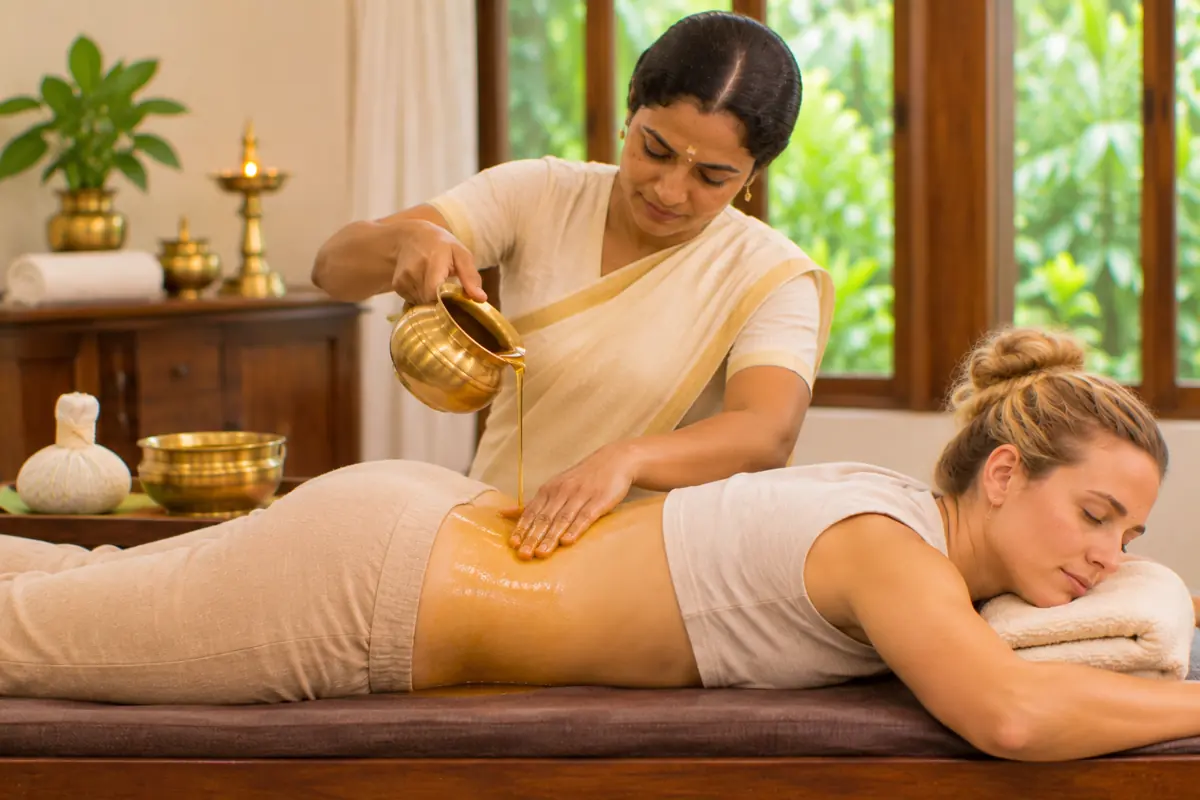
Gentler options, such as a warm herbal oil massage of areas away from the treated site, relaxation therapies for the head and shoulders and warm herbal applications to the legs, are often considered first and only with your doctor's agreement. Therapies directly over the treated area are generally left until your specialist says they are appropriate, and some are never needed. The physician explains each therapy and its purpose.
Movement and physiotherapy
Most spine specialists encourage a graded return to movement. A physiotherapist at the centre can continue the exercises you were given, adjust them to how you feel and teach posture, core support and safe ways to bend and lift. Yoga, if used, is gentle and chosen with care, with positions that load the treated area avoided until approved.
A day at a residential centre
| Time | Typical activity |
|---|---|
| Early morning | Warm water, gentle breathing |
| Morning | Gentle, approved therapy |
| Late morning | Physiotherapy: continuing your exercises |
| Midday | Light meal and rest |
| Afternoon | Short walk, relaxation |
| Evening | Light supper, calm, early sleep |
Medicines and follow-up
Please keep taking your prescribed medicines, including pain relief and any nerve medicines, as your doctor advises, and do not stop or change them without medical advice. Keep your follow-up appointments, or arrange a video review with your specialist during your stay. Tell the centre about any herbal medicines you take so that nothing clashes.
Taking it home
- Continue the exercises your physiotherapist teaches.
- Keep good posture, and move often.
- Lift and bend safely.
- Keep a calm routine and sleep well.
- Follow up with your specialist and share the centre's summary.
Setting honest expectations
Recovery after a non-surgical treatment varies, and no programme can promise a particular result or prevent the pain from returning. A residential stay can offer rest, structure, supervised movement and comfort, and a thoughtful team will speak of steady progress and good habits, working alongside your specialist.
Working alongside your own doctors
Please keep your own doctors informed. Share your medical summary, bring your reports and keep taking whatever you have been prescribed. Please share every plan with your own doctors before you begin. Please do not change medicines without medical advice.
Choosing a centre
Look for a qualified Ayurvedic doctor (BAMS or MD Ayurveda), registered with the appropriate board, a physiotherapist on the team, experience with spine guests, a hospital nearby and a willingness to work within your specialist's advice. Be cautious of anyone who promises to cure back pain or who offers strong manipulation.
Planning the journey
Apply for your e-Medical visa on India's official portal, usually with a hospital letter, a few weeks before travel. It is valid for 60 days from first arrival, allows three entries and cannot be extended. Book flights after approval, arrange travel insurance and choose an arrival time that gives you a rested first day. Check the portal for current rules before you apply.
Your friend and hand-holder in planning your recovery: MyVaidyam
A well-timed plan makes recovery calmer, and that is where MyVaidyam comes in. We walk with you from your very first question to the day you return home, answering every question patiently and making sure that nothing is left to chance.
- An online consultation with an Ayurvedic physician to discuss your treatment and goals.
- Help preparing your reports, procedure notes and questions for your specialist.
- Guidance on choosing a reputable centre that works within your doctor's advice.
- Help understanding your written plan.
- Support with your e-Medical visa documents, flights, airport pickup and accommodation.
- A warm point of contact during your stay, and follow-up after you return home.
You are welcome to reach out at any stage. We would be delighted to help you begin.