Knowing which these are is a kindness to yourself, and it lets you plan an Ayurvedic stay on a firm, reassuring footing.
This guide explains in calm, plain language which spine symptoms call for conventional medical evaluation before you consider Ayurveda, why this order matters, what to bring to your doctor and how to plan afterwards. And throughout, it shows how MyVaidyam can walk beside you as your friend and guide.
Ayurveda is offered here as a complementary, supportive approach that works alongside your own doctor's care, never as a replacement for it. It is not a diagnostic guide, and only a doctor can assess your symptoms.
Quick Facts - Which Spine Symptoms Require Conventional Medical Evaluation Before Ayurveda?
| Topic | Summary |
|---|---|
| Purpose | To make sure supportive care starts from a clear diagnosis |
| Who evaluates | Your own doctor or a spine specialist |
| Typical steps | Examination, and scans or tests if needed |
| Then | An Ayurvedic plan, shared with your doctors |
| Not | A substitute for medical evaluation |
| Where it starts | An online pre-consultation |
| Visa | e-Medical visa: 60 days from first arrival, triple entry, non-extendable |
| Your companion | MyVaidyam: planning, coordination and support before, during and after |
Why medical evaluation comes first
Ayurvedic centres offer gentle, supportive care for comfort, movement and wellbeing. They are not set up to diagnose or treat conditions that need urgent or specialist medical attention. A short visit to your own doctor, before you plan, ensures that your journey begins with clarity and that you travel with confidence, rather than with questions in the back of your mind.
Start with a conversation with your doctor
| Change in strength or feeling | Weakness, numbness or tingling that is new or spreading |
|---|---|
| After an injury | Pain following a fall, accident or blow |
| With other symptoms | Fever, unexplained weight loss or feeling generally unwell |
| Bladder or bowel changes | Any new change in control |
| Severe or worsening pain | Pain that is intense, constant or disturbs sleep |
This list is a general guide, and your doctor will tell you what matters in your particular case. If you are unsure, simply ask.
New or spreading weakness, numbness or tingling
A change in strength or sensation in an arm or leg, especially one that is new, spreading or getting worse, is worth bringing to your doctor promptly. It may be nothing serious, but it is the kind of symptom that deserves a proper examination, and sometimes imaging. Please do not wait until your travel date.
Pain after an injury
If your pain began after a fall, accident or blow, it is wise to have it checked before any massage, steam or movement therapy. Your doctor can confirm that the spine is stable and advise what activity is suitable, so that supportive care is chosen safely.
Pain with other symptoms
Back or neck pain together with fever, unexplained weight loss, a history of cancer, or a general feeling of being unwell deserves medical attention first. These combinations are uncommon, but your doctor will want to look at the whole picture, and it is always better to know.
Changes in bladder or bowel control
Any new difficulty controlling the bladder or bowel, or numbness in the area between the legs, alongside back pain needs prompt medical attention, and should not be delayed for any reason. This is rare, but it is one of the clearest signs that a doctor should see you without waiting.
Severe, constant or night pain
Pain that is intense, steady, not eased by rest or position, or that regularly wakes you from sleep should be discussed with your doctor. Likewise, pain that is steadily getting worse over weeks rather than easing is worth checking. Your doctor may suggest tests, and the results will help shape any supportive plan.
Other times to check first
- You have had spine surgery recently, or have implants.
- You have osteoporosis, or a history of fractures.
- You take blood-thinning medicines.
- You are pregnant.
- You have been told by a doctor to avoid certain movements.
What to bring to your doctor
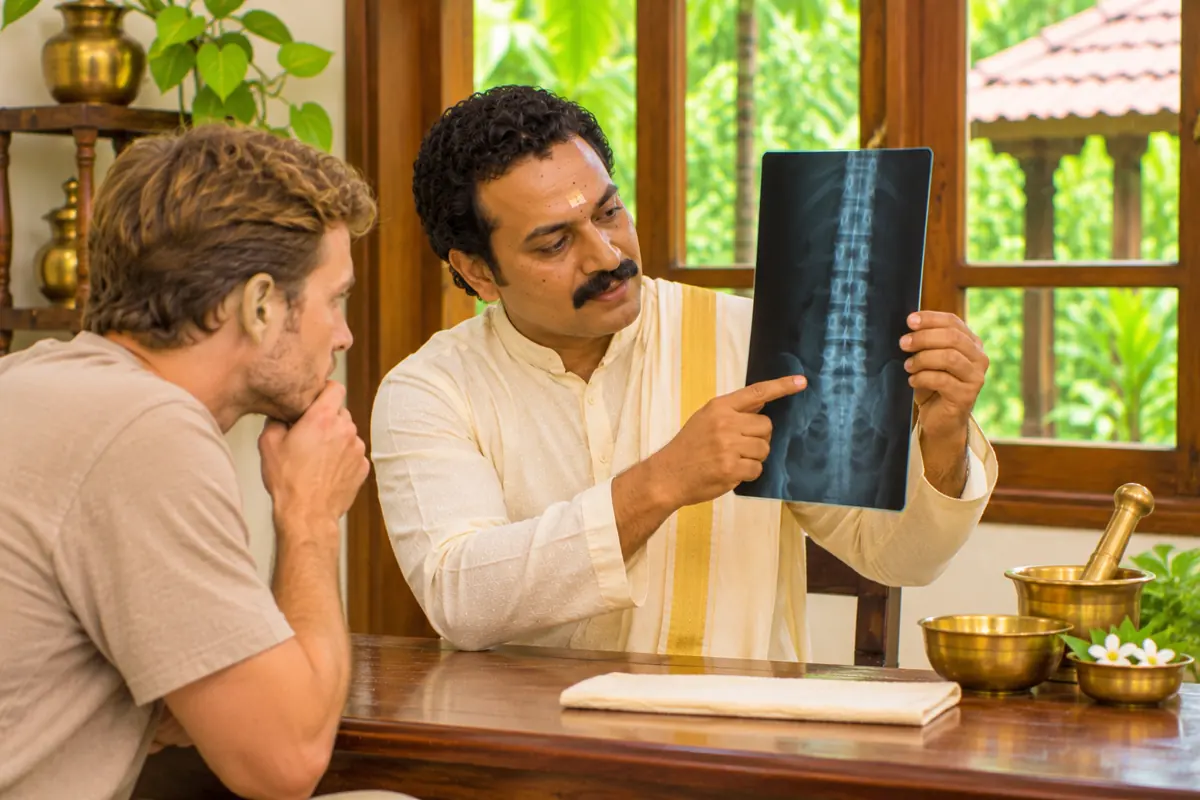
It helps to jot down when the pain started, what it feels like, what makes it better or worse, what medicines you take and what you hope to do. Bring any earlier scans or reports. Ask your doctor directly whether you are fit to travel, whether any movements or therapies should be avoided and whether a follow-up is needed. A short letter from your doctor is also helpful to share with the centre.
After your evaluation
Once you have been assessed, the way forward is usually reassuring. If your doctor is happy that your back pain is mechanical, a supportive programme of warmth, gentle movement, rest and good routine can be planned with confidence. If your doctor advises treatment first, that comes first, and an Ayurvedic stay can be considered later. Either way, you will know where you stand.
Neck symptoms deserve the same care
Everything said above applies to the neck as well. New weakness or numbness in the arms or hands, pain after a fall, difficulty with balance or walking, or severe, worsening pain are all good reasons to see a doctor first. Most neck stiffness from posture or sleeping awkwardly is harmless, and your doctor will help you tell the difference.
If you are already under a specialist
If you already see a spine specialist or have had scans, ask them directly whether a supportive Ayurvedic programme is suitable, and whether any movements or therapies should be avoided. Their answer, in writing if possible, is the most useful document you can bring to the centre.
A reassuring perspective
It helps to remember that the great majority of back and neck pain is not serious. Seeing a doctor first is not a sign that something is wrong; it is a simple step that lets everyone, including you, proceed calmly. Most guests find that it makes the whole planning process feel lighter.
Planning around your visa
Once you are cleared, plan with your physician. The e-Medical visa is valid for 60 days from first arrival, with triple entry and no extension, so choose dates thoughtfully and leave a few spare days at the end.
Working alongside your own doctors
Please keep your own doctors informed. Share your medical summary, bring your reports and keep taking whatever you have been prescribed. Please keep your own doctors involved, and keep taking prescribed medicines as advised. Please do not change medicines without medical advice.
Choosing a centre that welcomes this approach
Look for a qualified Ayurvedic doctor (BAMS or MD Ayurveda), registered with the appropriate board, who asks for your reports, welcomes your doctor's advice and explains plainly what the programme can and cannot do. Be cautious of anyone who invites you to skip medical evaluation, or who promises to cure spinal conditions.
Planning the journey
Apply for your e-Medical visa on India's official portal, usually with a hospital letter, a few weeks before travel. It is valid for 60 days from first arrival, allows three entries and cannot be extended. Book flights after approval, arrange travel insurance and choose an arrival time that gives you a rested first day. Check the portal for current rules before you apply.
Your friend and hand-holder in preparing well: MyVaidyam
A clear start makes for a calm journey, and that is where MyVaidyam comes in. We walk with you from your very first question to the day you return home, answering every question patiently and making sure that nothing is left to chance.
- An online pre-consultation with an Ayurvedic physician who reviews your reports and your doctor's advice.
- Help preparing your health summary and a list of questions for your doctor.
- Guidance on choosing a reputable centre that welcomes medical coordination.
- Help understanding your written plan.
- Support with your e-Medical visa documents, flights, airport pickup and accommodation.
- A warm point of contact during your stay, and follow-up after you return home.
You are welcome to reach out at any stage. We would be delighted to help you begin.