This is the heart of what makes Ayurveda feel so personal: before suggesting anything, the physician takes time to understand who you are and how you are, in two senses that Ayurveda calls prakriti and vikriti.
This guide explains what these two words mean, how doctors assess them, what to expect in your first consultation, why personalised, constitution-based care matters, and how to prepare for an online pre-consultation. And throughout, it shows how MyVaidyam can walk beside you as your friend and guide.
Ayurveda is offered here as a complementary, supportive approach that works alongside your own doctor's care, never as a replacement for it. Prakriti and vikriti are traditional frameworks for personalising supportive care. They are not a substitute for modern medical diagnosis.
Quick Facts - How Ayurvedic Doctors Assess Prakriti and Vikriti Before Treatment
| Topic | Summary |
|---|---|
| Prakriti | Your natural constitution, traditionally described by the doshas (vata, pitta, kapha) |
| Vikriti | Your present state of balance, which can shift with life and season |
| How it is assessed | Detailed history, observation, examination, reports |
| Why it matters | It shapes the choice, intensity and timing of supportive care |
| Not | A medical diagnosis, or a personality test |
| Where to begin | An online pre-consultation with an Ayurvedic physician |
| Visa | e-Medical visa: 60 days from first arrival, triple entry, non-extendable |
| Your companion | MyVaidyam: planning, coordination and support before, during and after |
Two words that shape your plan
Ayurveda describes every person through the three doshas, vata, pitta and kapha, which are traditional ways of understanding movement, transformation and structure in the body and mind. Everyone carries all three, in a pattern that is individual to them.
Prakriti is the pattern you were born with, your constitution. It is considered steady through life and explains much about your natural build, digestion, energy, sleep and temperament. Vikriti is the pattern as it is now, shaped by your diet, stress, season, age and health. A good assessment looks at both: prakriti tells the physician who you are, vikriti tells them where you are today.
Who you are, and how you are today
Prakriti
Your natural constitution
- Your lifelong blueprint
- Considered stable over life
- Shapes build, digestion, temperament, sleep
- Guides what suits you best
Vikriti
Your present state
= A plan shaped for you, not for a diagnosis alone
- How balance looks right now
- Can change with season, stress, diet
- Shows where support is needed
- Guides what to do first
When the two are compared, the physician can see where you are away from your natural balance and what kind of support is likely to be gentle and effective. This is why two people with the same complaint may receive quite different advice.
How doctors assess your prakriti
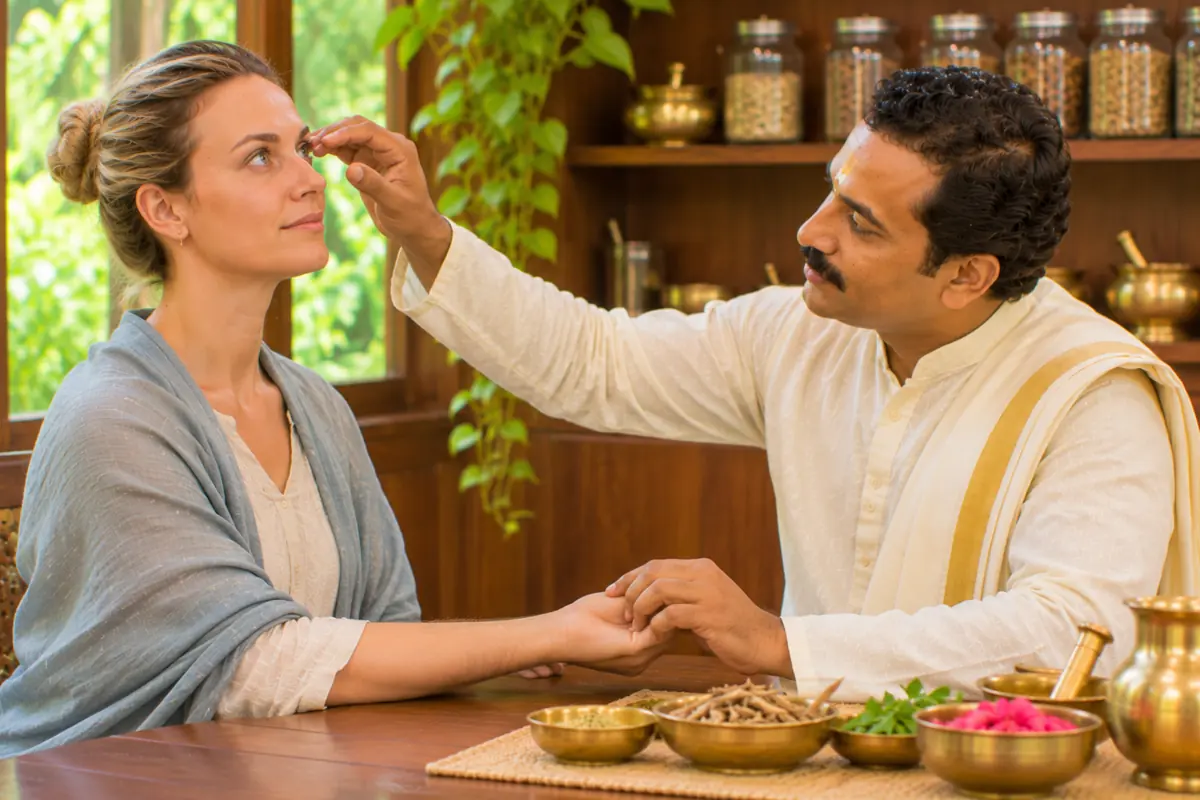
Assessment is a conversation as much as an examination. Classical texts describe a thorough, structured approach, and in practice the physician brings together several things:
| What is looked at | What it helps to understand |
|---|---|
| History and conversation | Your digestion, appetite, sleep, energy, habits, temperament, preferences for climate and food, and your health through life |
| Observation | Build, skin, hair, eyes, tongue, voice and general manner |
| Touch and examination | Gentle examination, including the pulse, as traditionally practised |
| Strength and digestion | How robust you are, and how well you digest food, which guide how gentle or active a plan should be |
| Your reports | Scans, blood tests and diagnoses from your own doctors |
No single sign decides anything. A careful doctor builds a picture over the whole conversation, and the picture often becomes clearer over the first days of a stay.
How doctors assess your vikriti
Vikriti is explored through the reason you have come. What are your symptoms, when did they begin, what makes them better or worse, and how have they changed with seasons, stress or diet? The physician considers your age, your daily routine, your work and your environment, because all of these shape how balance looks today.
Vikriti is not fixed. It moves as life moves, which is why good Ayurvedic care involves regular review, with the plan adjusted as you respond.
Your first consultation: what to expect
Consultations are unhurried and friendly. A typical visit goes like this:
- A warm welcome. The physician asks what you hope to achieve.
- A detailed conversation. Questions about your health, habits, digestion, sleep and daily life.
- Review of reports. Your scans, tests and medicines are read carefully.
- Examination. Gentle, respectful and explained as it goes.
- A shared plan. The physician explains what they recommend and why, and you ask questions.
Why constitution-based treatment matters
The point of all this assessment is not labels but fit. When care is shaped around the person, several things follow:
- The right food. Warm and nourishing for one person, lighter for another.
- The right therapies. Which oils, which warmth, how gentle and how long.
- The right pace. Some people need a slower, softer start, others can go further sooner.
- The right timing. Season, stage of life and current strength all matter.
- A plan you can follow. Habits that fit your life are the ones that last.
Two people may arrive with the same condition and leave with different programmes. In Ayurveda, that is not inconsistency. It is the whole idea.
The three patterns in everyday words
The doshas are often described in simple terms. These are traditional descriptions, and most people are a blend rather than a single type.
| Pattern | Often described as |
|---|---|
| Vata | Lean, quick, creative; may feel cold, sleep lightly and have variable appetite |
| Pitta | Medium build, focused, determined; may feel warm and have a strong appetite |
| Kapha | Sturdy, calm, steady; may sleep deeply and feel slow to start in the morning |
These are only illustrations. Your physician looks at the whole picture, and online quizzes, while entertaining, cannot replace a conversation.
Season, age and place also matter
Ayurveda pays attention to the setting in which you live. The season of the year, the climate of your home and the stage of life you are in all influence balance, and a thoughtful physician takes them into account. A guest arriving from a cold winter, for example, may be advised differently from one arriving from tropical heat, and a young professional will be advised differently from a retired grandparent.
This is one reason many people find the personal conversation so reassuring. It is not a generic programme. It is care that notices you, your climate, your routines and your life.
Questions people often ask
Can my constitution change? Tradition regards prakriti as lasting. What changes is vikriti, and the aim of care is to support balance.
Am I just one type? Most people carry a blend, and the physician describes your own pattern.
Is this a diagnosis? No. It is a traditional way of personalising supportive care, alongside the diagnosis your own doctors make.
Preparing for an online pre-consultation
An online consultation is a lovely way to begin, and a little preparation makes it more useful:
- Your medical summary, recent reports and a list of your medicines and supplements.
- A few notes on your sleep, digestion, energy and appetite over recent weeks.
- Your goals, in your own words.
- Any questions you would like to ask.
- A quiet place and a good connection for the call.
Working alongside your own doctors
Please keep your own doctors informed. Share your medical summary, bring your reports and keep taking whatever you have been prescribed. Ask your Ayurvedic physician to write down any herbal preparations so that you can show them at home. Please do not change medicines without medical advice.
Choosing a physician who assesses properly
Look for a qualified Ayurvedic doctor (BAMS or MD Ayurveda), registered with the appropriate board, who sees you personally, takes time over your history and explains the plan in writing. Be cautious of anyone who offers a plan before asking about you, or who promises results.
Planning the journey
Once your plan is shaped, apply for your e-Medical visa on India's official portal, usually with a hospital letter, a few weeks before travel. It is valid for 60 days from first arrival, allows three entries and cannot be extended. Book flights after approval, arrange travel insurance and choose an arrival time that gives you a rested first day. Check the portal for current rules before you apply.
Your friend and hand-holder on the way to your consultation and beyond:
MyVaidyam
Beginning an Ayurvedic journey from far away can feel like a leap, and that is where MyVaidyam comes in. We walk with you from your very first question to the day you return home, answering every question patiently and making sure that nothing is left to chance.
- An online pre-consultation with an Ayurvedic physician, so that your plan is personal from the start.
- Help preparing your health summary and organising your reports.
- Guidance on choosing a reputable centre and a programme that suits your constitution and goals.
- Help checking what is included and what is arranged separately.
- Support with your e-Medical visa documents, flights, airport pickup and accommodation.
- A warm point of contact during your stay, and follow-up after you return home.
You are welcome to reach out at any stage. We would be delighted to help you begin.