This guide gives practical, friendly advice on posture, ergonomics and home care after an Ayurveda back programme: how to sit, stand and lift, how to arrange your workspace and bedroom, how to keep moving, what to do on a flare-up and how to stay in touch with the centre. And throughout, it shows how MyVaidyam can walk beside you as your friend and guide.
Ayurveda is offered here as a complementary, supportive approach that works alongside your own doctor's care, never as a replacement for it.
Quick Facts - Posture, Ergonomics and Home Care After an Ayurveda Back Program
| Topic | Summary |
|---|---|
| Goal | To keep the benefit of your programme at home |
| Posture | Sit, stand and lift with support |
| Ergonomics | Workspace, bed, kitchen, car |
| Movement | Daily exercises and walking |
| Flare-ups | Rest briefly, move gently, call your team |
| Follow-up | Doctor and centre |
| Visa | e-Medical visa: 60 days from first arrival, triple entry, non-extendable |
| Your companion | MyVaidyam: planning, coordination and support before, during and after |
Where the benefit is kept
A back programme teaches your body new habits: moving more freely, holding itself well, relaxing muscles that were always tense. These habits need a home to live in. When your surroundings support them, they grow stronger; when they do not, old patterns slip back.
Four places where the back is helped at home
Bed
Supportive mattress, pillow between knees
Desk
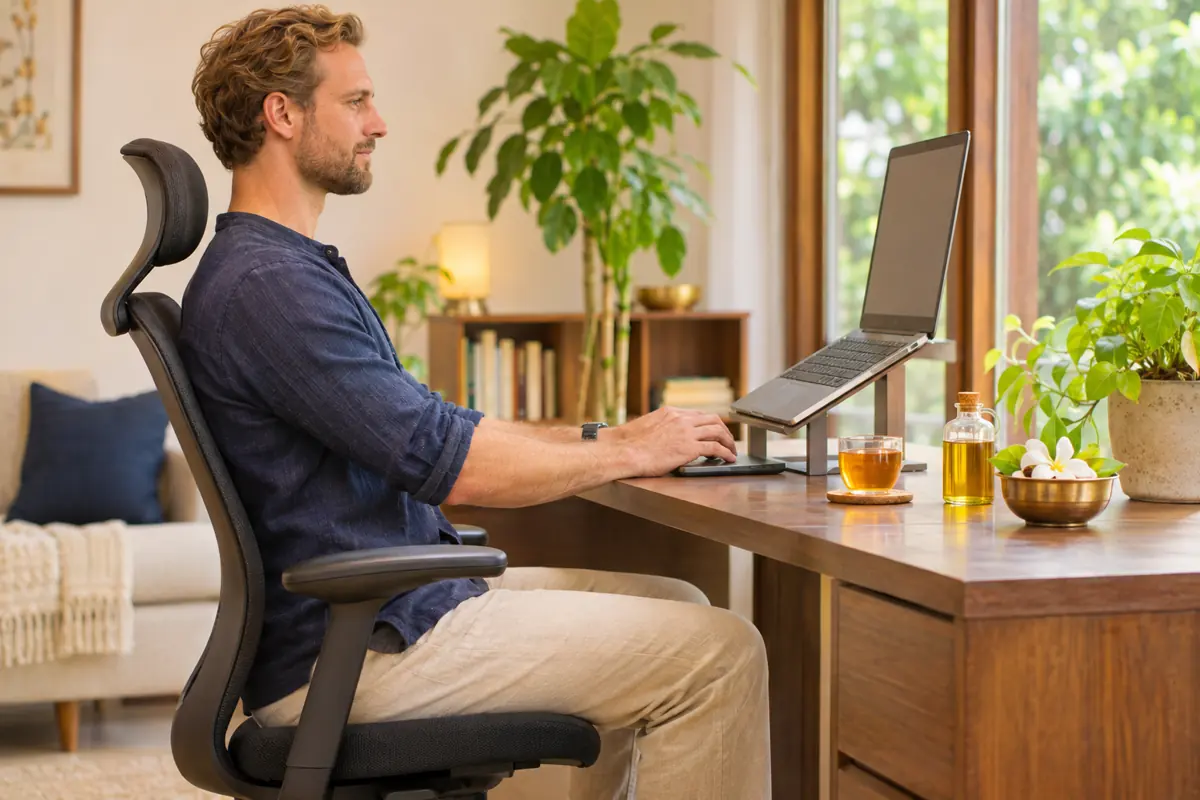
Chair support, screen at eye level
Kitchen
Work at the right height, avoid long bending
Car
Seat close, back supported, short stops
These are the places most people spend the most time in.
Sitting well
- Sit with your hips back in the chair and your lower back supported.
- Keep feet flat on the floor, knees about level with hips.
- Avoid sitting for more than 30 to 45 minutes without standing.
- Use a small cushion or rolled towel behind the lower back if needed.
- Avoid sitting on a low sofa for long periods.
Standing and lifting
Stand tall with weight even on both feet, and shift position often. When lifting, bring the object close, bend the knees and hips, keep the back straight and let the legs do the work. Avoid twisting while carrying; turn with your feet.
Your workspace
Set the screen at eye level and an arm's length away, with elbows close to your sides and wrists straight. Keep the keyboard and mouse close. If possible, alternate sitting and standing.
Sleeping and resting
Many backs do well on a medium-firm mattress. Sleep on your side with a pillow between the knees, or on your back with a pillow under the knees. Avoid sleeping on your stomach.
Keeping up exercises and walking
Continue the exercises your physiotherapist taught, ideally at the same time each day. Short regular sessions beat occasional long ones. Walk daily, building up gradually.
A balanced routine
Keep some of the rhythm of the centre: regular meals, warm water, an early bedtime and a few minutes of breathing or relaxation.
When the back flares
Occasional flare-ups are normal. Rest briefly in a comfortable position, keep moving gently, use warmth if it helps and ease back into activity. Take your prescribed medicines as your doctor advises, and contact your doctor or the centre if the pain is unusual, spreads or is accompanied by weakness or numbness.
Setting honest expectations
Back pain tends to come and go, and no programme can promise that it will not return. Good habits make flare-ups fewer, shorter and easier to manage, and that is a gain worth having.
Working alongside your own doctors
Please keep your own doctors informed. Share your medical summary, bring your reports and keep taking whatever you have been prescribed. Please keep taking prescribed medicines, and keep your own doctors informed. Please do not change medicines without medical advice.
Planning the journey
Apply for your e-Medical visa on India's official portal, usually with a hospital letter, a few weeks before travel. It is valid for 60 days from first arrival, allows three entries and cannot be extended. Book flights after approval, arrange travel insurance and choose an arrival time that gives you a rested first day. Check the portal for current rules before you apply.
Your friend and hand-holder after you return home: MyVaidyam
The journey does not end at the airport, and neither does our support. That is where MyVaidyam comes in. We walk with you from your very first question to the day you return home, answering every question patiently and making sure that nothing is left to chance.
- Help preparing your questions and notes for follow-up with the centre.
- Coordination of video check-ins with your Ayurvedic physician.
- Help sharing the centre's summary with your doctors at home.
- Guidance on organising your home exercise and daily routine.
- Support if you consider another stay, including e-Medical visa documents, flights and accommodation.
- A warm point of contact for any question, long after you return home.
You are welcome to reach out at any stage. We would be delighted to stay beside you.