This guide explains in plain language what facial weakness may mean, why your doctor must assess its cause first, how supportive Ayurvedic care may sit alongside rehabilitation, what facial exercises and eye care involve, how to protect comfort in everyday life and how to plan a stay. And throughout, it shows how MyVaidyam can walk beside you as your friend and guide.
Ayurveda is offered here as a complementary, supportive approach that works alongside your own doctor's care, never as a replacement for it. It does not promise recovery of facial movement.
Quick Facts - Ayurveda Support for Facial Weakness Rehabilitation for International Patients
| Topic | Summary |
|---|---|
| Common causes | Stroke, Bell's palsy and other nerve conditions |
| First step | Medical assessment of the cause |
| Central | Facial exercises and eye care, with a therapist |
| Ayurvedic support | Gentle warmth, relaxation, diet, routine |
| Typical length | Two to three weeks |
| Not | A promise of restored movement |
| Visa | e-Medical visa: 60 days from first arrival, triple entry, non-extendable |
| Your companion | MyVaidyam: planning, coordination and support before, during and after |
What facial weakness may mean
Facial weakness occurs when the nerves or brain pathways that move the face are affected. After a stroke, it often involves the lower part of the face on one side. In Bell's palsy, the whole side of the face, including the forehead and eyelid, can be affected, usually appearing over a short time. There are other possible causes, which is why any new facial weakness should be assessed by a doctor promptly, rather than waiting.
Gentle practice for the face
Warm-up
Warm cloth, gentle stroking
Mirror work
Slow, symmetrical movements
Eyes and brows
Gentle closing and lifting
Cheeks and lips
Smiling, puckering, blowing
Jaw
Easy opening and closing
Rest
Pauses between practice
The picture shows the elements of a typical gentle facial programme. Your therapist will tailor it to you.
See your doctor first
Please have your facial weakness properly assessed. Ask what is causing it, what medical treatment is appropriate, what recovery is typical for your condition, whether any scans or tests are needed and whether you are fit to travel. Bring your reports and a short letter to share with the centre. Supportive care should begin only on this foundation.
Protecting the eye
If the eyelid does not close fully, the eye can become dry and irritated, and protecting it is a priority. Your doctor may advise lubricating drops, ointment at night or taping the eyelid. Please follow that advice exactly, and tell the centre. Wearing sunglasses outdoors, avoiding dust and windy places and reporting any redness, pain or change in vision to a doctor promptly are sensible habits.
Gentle facial exercises
A trained therapist can teach slow, controlled facial exercises, often in front of a mirror: gently closing the eyes, raising the eyebrows, smiling, puckering the lips and gently blowing out the cheeks. The emphasis is on small, symmetrical, unforced movement, rather than strong effort, because over-exertion can encourage unwanted muscle patterns. Short sessions, several times a day, are usually better than long ones.
How Ayurveda may support
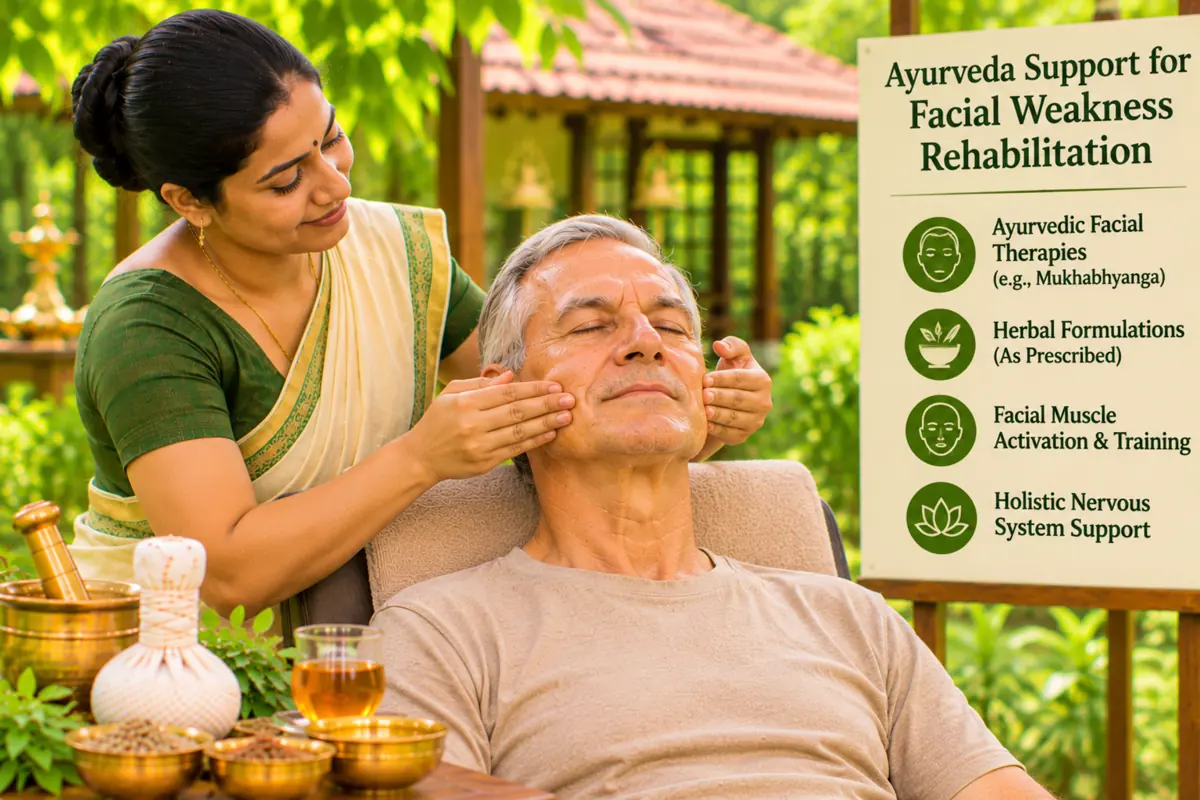
Ayurvedic centres experienced in neurological care may offer gentle, warm supportive care: soft, warm herbal oil application and light touch around the face and head, performed by trained therapists with great care, a nourishing, simple diet, good sleep and a calm routine. These are traditionally described as soothing. They are supportive only, and should be used within your doctor's advice. Strong massage, pulling or stimulating the muscles is not appropriate.
Eating, speaking and comfort
When the face is weak, chewing and drinking can be awkward, and food can collect on the weak side. Softer foods, small bites, sitting upright and taking time can help. If swallowing feels difficult, tell your doctors and a speech-language therapist promptly. Speech can sound different, and patient, unhurried conversation takes the pressure off.
Confidence and mood
A change in the face is deeply personal, and it can affect confidence and mood. A calm, kind environment and company that does not rush or stare can help. Breathing and relaxation practices are often included in supportive programmes. If low mood or anxiety is a concern, share it with your own doctors and the physician.
A day at a residential centre
| Time | Typical activity |
|---|---|
| Early morning | Warm water, eye care, gentle facial practice |
| Morning | Gentle supportive therapy and review |
| Midday | Soft, easy-to-eat meal and rest |
| Afternoon | Therapist-guided facial exercises, short walk |
| Evening | Eye care, light supper, early sleep |
Taking it home
- Continue the exercises as taught, in short sessions.
- Protect your eyes as your doctor advised.
- Eat soft foods, slowly, sitting upright.
- Keep a calm routine and sleep well.
- Follow up with your own doctors and share the centre's summary.
Setting honest expectations
Recovery of facial movement varies greatly, depending on the cause, and many people improve over weeks to months. No programme can promise a particular outcome. A residential stay can offer calm, practice and encouragement, and a thoughtful physician will say plainly what to expect.
Working alongside your own doctors
Please keep your own doctors informed. Share your medical summary, bring your reports and keep taking whatever you have been prescribed. Please keep taking all prescribed medicines and continue your doctors' and therapists' advice. Please do not change medicines without medical advice.
Choosing a centre
Look for a qualified Ayurvedic doctor (BAMS or MD Ayurveda), registered with the appropriate board, experience with neurological conditions, a qualified therapist for facial exercises, a hospital nearby and a clear written plan. Be cautious of anyone who promises restored facial movement or suggests stopping medical treatment.
Planning the journey
Apply for your e-Medical visa on India's official portal, usually with a hospital letter, a few weeks before travel. It is valid for 60 days from first arrival, allows three entries and cannot be extended. Book flights after approval, arrange travel insurance and choose an arrival time that gives you a rested first day. Check the portal for current rules before you apply.
Your friend and hand-holder through your recovery: MyVaidyam
A gentle journey is best taken with a friend beside you, and that is where MyVaidyam comes in. We walk with you from your very first question to the day you return home, answering every question patiently and making sure that nothing is left to chance.
- An online consultation with an Ayurvedic physician to discuss your needs.
- Help preparing your health summary, reports and doctors' advice.
- Guidance on choosing a reputable centre with experience and therapy support.
- Help planning comfortable travel for you and a companion.
- Support with your e-Medical visa documents, flights, airport pickup and accommodation.
- A warm point of contact during your stay, and follow-up after you return home.
You are welcome to reach out at any stage. We would be delighted to help you begin.