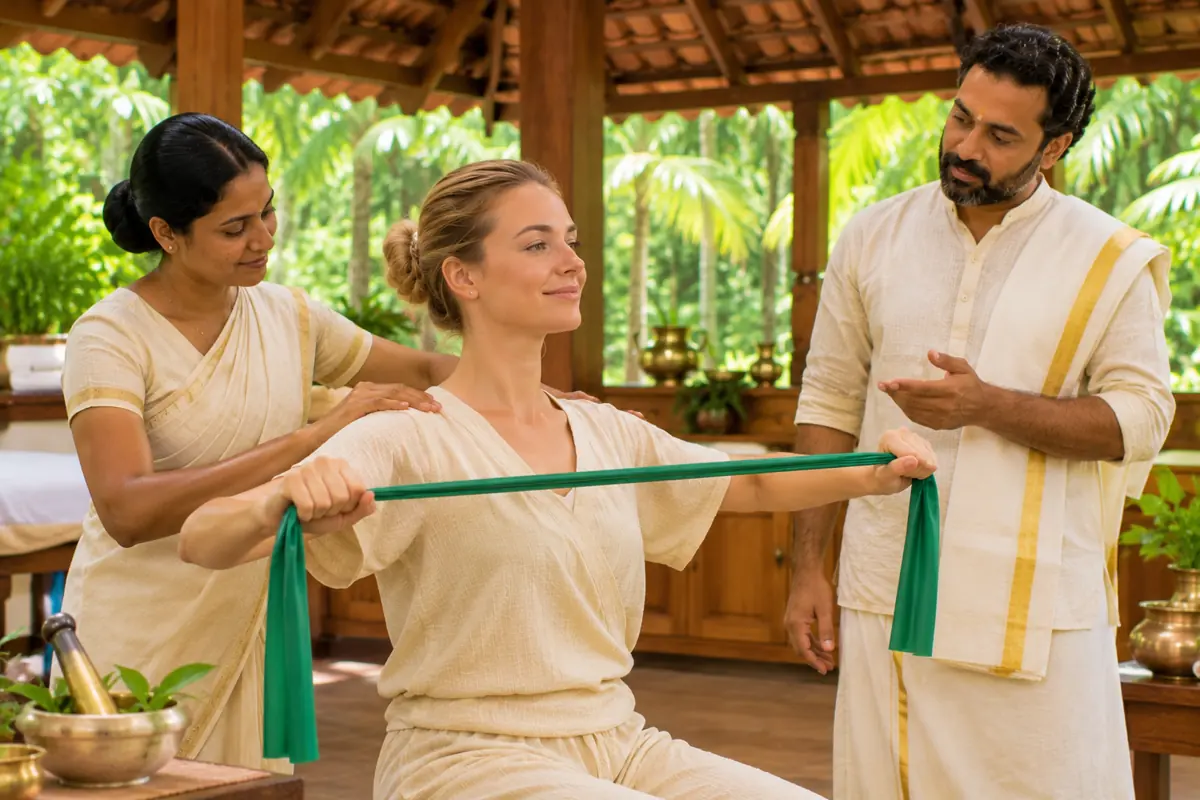
Warm oils and steam relax the body, and guided movement helps it make the most of that ease.
This guide explains how Ayurveda and physiotherapy can work together, when integrated care makes sense, how a day might be arranged, whether Panchakarma and physiotherapy can be combined, what older guests should know about mobility, how to choose a centre and how to plan. And throughout, it shows how MyVaidyam can walk beside you as your friend and guide.
Ayurveda is offered here as a complementary, supportive approach that works alongside your own doctor's and physiotherapist's care, never as a replacement for it. Integrated care supports comfort and mobility. It does not promise a cure.
Quick Facts - Physiotherapy With Ayurveda
| Topic | Summary |
|---|---|
| Idea | Ayurveda eases and nourishes; physiotherapy guides movement |
| Often used for | Joint and back comfort, mobility, recovery support, senior mobility |
| Needs | A qualified physiotherapist and an Ayurvedic physician who coordinate |
| Before you travel | Your own doctor's or surgeon's agreement |
| Not | A cure, or a replacement for your own treatment |
| Typical lengths | Two to four weeks, shaped by the team |
| Visa | e-Medical visa: 60 days from first arrival, triple entry, non-extendable |
| Your companion | MyVaidyam: planning, coordination and support before, during and after |
Why combine the two?
Ayurveda and physiotherapy approach the body from different directions, and that is their strength. Ayurvedic therapies, such as warm herbal oil massage and gentle steam, are traditionally used to relax muscles, ease stiffness and create a feeling of comfort. Physiotherapy, in turn, helps people move better, with guided exercises for strength, balance, posture and walking.
Put together, they can make a very satisfying pair. A body that is warm and relaxed is often more willing to stretch and move, and movement helps to carry the benefits of the therapies into everyday life.
When integrated care makes sense
Integrated care is often chosen by guests who:
- live with joint stiffness or back and neck discomfort and want gentle, supportive care;
- are recovering from surgery, with their surgeon's agreement, and want help regaining movement;
- are rebuilding strength and mobility after a period of illness or inactivity;
- are older and wish to stay steady, strong and independent;
- have a neurological condition and want supportive rehabilitation alongside their usual care.
In every case, your own doctors' advice comes first, and the plan is shaped around your health and goals.
Can Panchakarma be combined with physiotherapy?
This is a common question, and the answer is that it depends on the stage. During the preparation and recovery stages, when therapies are gentle, light physiotherapy is often possible. Around the main Panchakarma procedures, the body needs rest, and strenuous exercise is usually set aside. A thoughtful team will plan the sequence together, so that movement is encouraged when it helps and paused when rest matters more.
If you are interested in both, tell the centre at the start and ask how they coordinate the two.
How a day might be arranged
A typical day weaves the two together. The morning may begin with gentle movement or yoga, followed by an Ayurvedic therapy such as warm oil massage and steam. After a rest, a physiotherapy session may follow, when the body is warm and relaxed, with exercises matched to your needs. Afternoons are quiet, and evenings gentle. Sessions are short and unhurried, and your team adjusts the plan as you progress.
What a physiotherapy session involves
A first session usually begins with a conversation and an assessment of how you move. The physiotherapist then teaches exercises for strength, flexibility, balance or walking, shows you how to do them safely and adjusts them as you improve. You will leave each session knowing what to practise, so that your home routine is ready when you return.
Physiotherapy and Ayurveda for senior mobility
For older guests, integrated care can be especially welcome. Warm, unhurried Ayurvedic therapies and gentle diet support comfort, while physiotherapy focuses on balance, steadiness and strength for daily life. Good centres pay attention to safety, with handrails, non-slip floors and support when walking. Tell the team about any history of falls, dizziness or difficulty walking, so that sessions can be planned with care, and discuss the plan with your own doctor before you travel.
After surgery
If you are recovering from surgery, please ask your surgeon whether travel and therapy are suitable and when. Share your operation notes and rehabilitation instructions with the centre, so that the physiotherapist can follow them. Keep taking your prescribed medicines, and let both your surgeon and the centre know about any concerns. Recovery plans are always led by your own doctors.
Taking your exercises home
One of the most valuable gifts of an integrated stay is a simple home routine. Before you leave, ask the physiotherapist to write down your exercises, show you how to do them and tell you how often to practise. Ask the Ayurvedic physician for a short daily routine too, such as warm water, a regular meal rhythm and, where suitable, a gentle self-massage. Share both with your own doctors or physiotherapist at home, so that your care continues smoothly.
Questions to ask the team
A few simple questions help you understand how the two kinds of care will work together:
- Will my Ayurvedic physician and physiotherapist share one plan?
- How will sessions be timed around my therapies?
- What exercises will I be asked to do, and how often?
- What happens if I feel tired or sore?
- Can you send a summary to my own doctor?
Working alongside your own doctors
Please keep your own doctors and physiotherapist informed. Share your medical summary, bring your reports and keep taking whatever you have been prescribed. Ask the centre for a written summary at the end of your stay, with exercises to continue at home, and share it with your team. Please do not change medicines without medical advice.
Choosing a centre for integrated care
Look at these, roughly in order of importance:
- The physician. A qualified Ayurvedic doctor (BAMS or MD Ayurveda), registered with the appropriate board.
- The physiotherapist. A qualified, registered physiotherapist, with experience of your needs.
- Coordination. Evidence that the two teams share one plan.
- A written plan. Therapies, exercises, diet, inclusions and follow-up, in writing.
- Safety. Handrails, non-slip floors and nursing support.
- Honesty. Be cautious of promises of a cure or of sessions that feel rushed.
Planning the journey
Apply for your e-Medical visa on India's official portal, usually with a hospital letter, a few weeks before travel. It is valid for 60 days from first arrival, allows three entries and cannot be extended. Book flights after approval, arrange travel insurance and request airport assistance if you need it. Check the portal for current rules before you apply.
Your friend and hand-holder on the way to integrated care: MyVaidyam
Bringing two kinds of care together is easier with a friend, and that is where MyVaidyam comes in. We walk with you from your very first question to the day you return home, answering every question patiently and making sure that nothing is left to chance.
- An online consultation with an Ayurvedic physician to discuss how integrated care could look for you.
- Help preparing your health summary and sharing it with the centre and your own physiotherapist.
- Guidance on choosing a reputable centre with qualified physicians and physiotherapists.
- Help checking what is included and what is arranged separately.
- Support with your e-Medical visa documents, flights, airport assistance, pickup and accommodation.
- A warm point of contact during your stay, and follow-up after you return home.
You are welcome to reach out at any stage. We would be delighted to help you plan a supportive stay.