For many guests, it is the part of the journey that they carry home most easily.
This guide explains what yoga therapy is, how it differs from a yoga class, what a day may look like, how it can be personalised during an Ayurveda stay, how to choose a teacher and how to prepare. And throughout, it shows how MyVaidyam can walk beside you as your friend and guide.
Ayurveda is offered here as a complementary, supportive approach that works alongside your own doctor's care, never as a replacement for it.
Quick Facts - Yoga Therapy in India for International Wellness Travellers
| Topic | Summary |
|---|---|
| What it is | Yoga practices adapted to individual needs |
| Elements | Posture, breath, relaxation, meditation |
| Led by | A trained yoga therapist or physician |
| Suitable for | Beginners and experienced practitioners alike |
| Often combined with | An Ayurveda programme, with physician guidance |
| Not | A competitive or strenuous class |
| Visa | e-Medical visa: 60 days from first arrival, triple entry, non-extendable |
| Your companion | MyVaidyam: planning, coordination and support before, during and after |
What is yoga therapy?
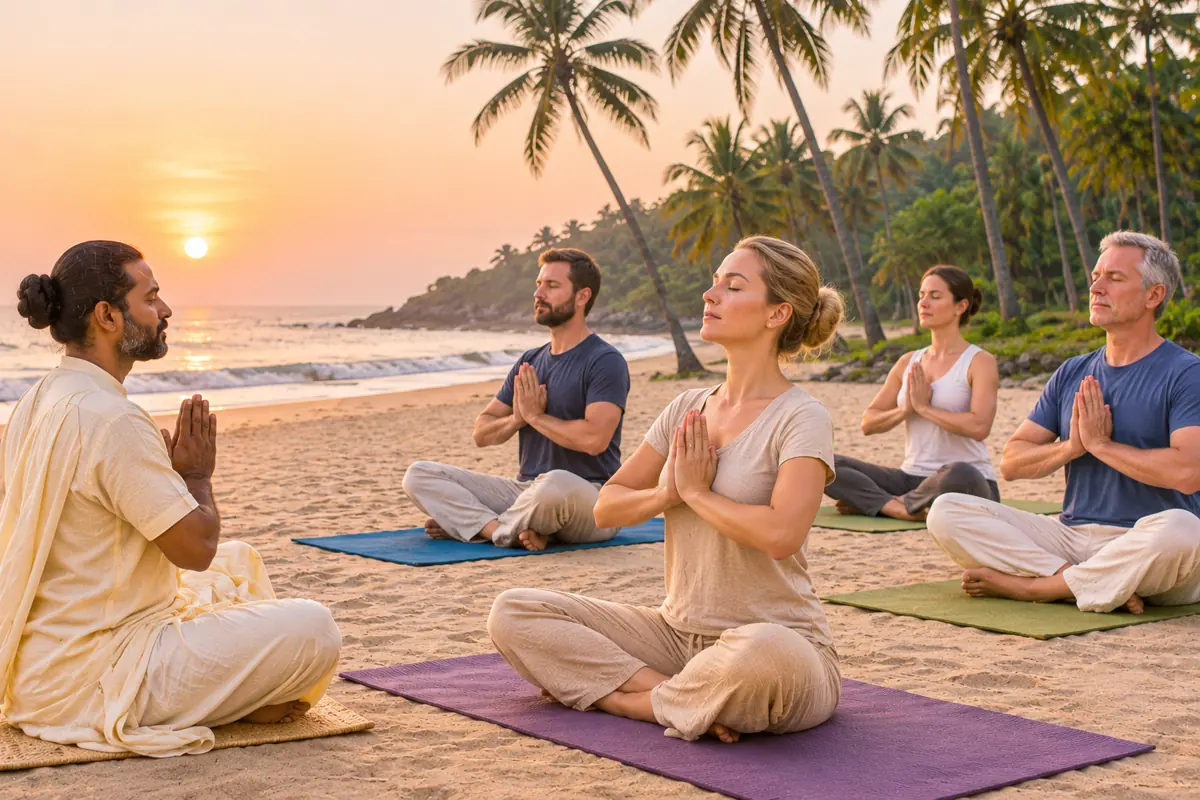
Yoga therapy uses the practices of yoga, such as gentle movement, breathing, relaxation and meditation, in a way that is chosen for the individual. Instead of a class where everyone follows the same sequence, a yoga therapist begins by understanding you: your health, your energy, your sleep, your stresses and what you hope for. The practices that follow are tailored to that conversation and adapted as you progress.
In India, yoga therapy is often offered within wellness and Ayurveda centres, and some institutions run dedicated yoga therapy programmes. This makes it easy to combine with other approaches, with each informing the others.
The pillars of a yoga therapy session
| Posture | Breath | Relaxation | Mind |
|---|---|---|---|
| Gentle, adapted movements | Calm, steady breathing | Deep rest and release | Meditation and focus |
The balance of these elements is shaped to suit you, and a session may emphasise one more than another.
How it differs from a yoga class
A general class is designed for a group and often moves at a set pace. Yoga therapy is slower, quieter and more personal. Postures are adapted to your body, with props and alternatives where needed. The teacher watches, adjusts and explains, and you are never expected to match anyone else. Many guests who have never practised yoga find that therapy sessions are the easiest and most welcoming way to begin.
Personalised yoga during an Ayurveda stay
Within an Ayurveda programme, yoga is often chosen to complement the therapies. During the preparation days, practice may be very gentle. Later, as energy returns, it can become a little more active, and in the recovery stage it often focuses on calm, breath and rest. Your Ayurvedic physician and yoga teacher can work together, so that what you do each morning fits what is happening in your plan, and you do not overdo anything.
What a day may look like
| Time | Typical activity |
|---|---|
| Early morning | Gentle practice, breathing and meditation |
| Mid-morning | Ayurvedic therapies as planned |
| Midday | Light, freshly cooked meal and rest |
| Afternoon | Quiet time, walking or a short relaxation session |
| Evening | Calm breathing, supper and early sleep |
Timings vary from centre to centre, and your plan will be shaped to you.
Who may enjoy it
Yoga therapy suits beginners, experienced practitioners, people who sit at desks all day, people who feel tired or tense and people who simply wish to learn a calming routine. Because practices are adapted, age and flexibility are not barriers. If you have a medical condition, injury or are pregnant, let your teacher and physician know first, so that the practices are chosen with care.
Learning something to take home
One of the great gifts of yoga therapy is that you leave with a short, simple routine of your own: a few gentle postures, a breathing practice and a relaxation exercise. Good teachers write these down or demonstrate them so that you can continue at home. Even ten minutes a day can keep the calm of your stay close.
Choosing a teacher or centre
Look for a teacher with recognised training in yoga therapy, ideally working alongside a qualified Ayurvedic doctor (BAMS or MD Ayurveda), a clear approach to individual assessment and a welcoming attitude to beginners. Be cautious of anyone who makes dramatic promises, pushes you beyond comfort or treats everyone the same.
How to prepare
- Wear comfortable, loose clothing.
- Tell your teacher about injuries, conditions and medicines.
- Arrive with an open mind and no need to be flexible.
- Bring a reusable water bottle.
- Practise a few minutes of gentle stretching and breathing before you travel.
Breath, the quiet centre of practice
Breathing practices, or pranayama, are a central part of yoga therapy. In a therapeutic setting they are taught gently: slow, even breaths, without strain, often seated or lying down. Many guests find that simply learning to breathe slowly and fully changes how they feel through the day. Practices involving breath holding or forceful breathing are introduced only when appropriate, and always under guidance.
Relaxation and sleep
Guided relaxation is often the favourite part of a session. Lying comfortably, you are led through the body, releasing tension in turn, until you rest in a state that is awake yet deeply calm. Many guests say it helps them sleep better, and the practice is easy to repeat at home with a recording or a few remembered steps.
Meditation and the quiet mind
Meditation in yoga therapy is simple and unforced. You might watch the breath, repeat a quiet word or listen to the sounds of the morning. There is no need to empty the mind. A few minutes of calm attention, practised regularly, is considered a valuable skill, and teachers will help you find a style that feels natural.
Yoga and Ayurveda together
Yoga and Ayurveda are traditionally described as sister sciences, each supporting the other. Ayurveda looks at your constitution, digestion and daily rhythm, while yoga offers movement, breath and stillness. In many centres, your Ayurvedic physician and yoga therapist share notes, so that your plan feels like one conversation rather than two separate programmes. For guidance on balancing these approaches, see our article on choosing between them.
Making the most of your sessions
- Arrive a few minutes early and settle quietly.
- Move within comfort, and never force a posture.
- Tell the teacher about anything that feels uncomfortable.
- Rest properly afterwards, with warm water.
- Ask for a written or recorded home routine.
Gentle movement for everyday life
Many guests are surprised by how small a useful practice can be. A few shoulder rolls, a slow forward bend, a seated twist and some deep breaths can ease a long day at a desk. Your teacher will show you versions that fit into a hotel room, an office or a quiet corner of your garden, so that yoga becomes a friendly companion rather than a task. Regularity matters far more than length or difficulty.
Working alongside your own doctors
Please keep your own doctors informed. Share your medical summary, bring your reports and keep taking whatever you have been prescribed. Please share your yoga plans with your own doctors, especially if you have a medical condition. Please do not change medicines without medical advice.
Planning the journey
Apply for your e-Medical visa on India's official portal, usually with a hospital letter, a few weeks before travel. It is valid for 60 days from first arrival, allows three entries and cannot be extended. Book flights after approval, arrange travel insurance and choose an arrival time that gives you a rested first day. Check the portal for current rules before you apply.
Your friend and hand-holder in finding the right yoga practice: MyVaidyam
The right teacher makes all the difference, and that is where MyVaidyam comes in. We walk with you from your very first question to the day you return home, answering every question patiently and making sure that nothing is left to chance.
- An online consultation to discuss your goals, including yoga therapy.
- Help preparing your health summary and any relevant reports.
- Guidance on choosing a reputable centre that combines yoga and Ayurveda.
- Help understanding how yoga fits into your programme.
- Support with your e-Medical visa documents, flights, airport pickup and accommodation.
- A warm point of contact during your stay, and follow-up after you return home.
You are welcome to reach out at any stage. We would be delighted to help you begin.