This guide explains the Ayurvedic view, what a stay typically includes and how to plan with confidence. Ayurveda is offered as a complementary, supportive approach alongside your own doctor's care, never a replacement for it.
Quick Facts - Ayurveda Programmes for Knee Osteoarthritis for International Patients in India
| Topic | Summary |
|---|---|
| Ayurvedic view | Sandhigata Vata, with joint stiffness and pain linked to vata |
| What a stay offers | External joint therapies, herbal guidance, diet, gentle movement |
| Usual care (NIAMS) | Exercise, weight management, pain relief, injections or surgery for some |
| Aim | Comfort and function |
| Reports to bring | Scans, blood tests, medicine list |
| Cost | Compare itemised, dated quotes |
Understanding knee osteoarthritis
The US National Institute of Arthritis and Musculoskeletal and Skin Diseases (NIAMS) describes osteoarthritis as a condition in which the cartilage that cushions the ends of the bones gradually wears down. The knee is one of the most commonly affected joints. People often notice aching or stiffness after rest, discomfort on stairs or when standing up from a chair, and a joint that feels less flexible than it used to. Age, previous injury, body weight and family history all play a part, and the course varies widely from person to person.
The reassuring message is that there is a lot you can do. Regular, suitable exercise, a comfortable weight, good footwear and well-chosen pain relief are the foundations of everyday care, and a number of people also benefit from injections or surgery. A residential Ayurveda stay is not a substitute for any of this. It is a supportive environment in which many of these healthy habits are easy to practise.
How Ayurveda describes knee joint problems
In Ayurveda, degenerative joint conditions are often discussed under Sandhigata Vata, in which aggravated vata in the joints is associated with pain, stiffness, cracking sounds and reduced movement. A good
Ayurvedic doctor will want to see your scans and reports alongside the traditional assessment.
Care typically combines external therapies for the joint, internal herbal medicines, diet and lifestyle guidance and gentle movement. A supportive programme aims at comfort and function.
Building on your usual care
NIAMS describes osteoarthritis as a condition in which joint cartilage gradually wears down, with age, previous injury, body weight and family history all playing a part. Evidence-based care generally includes exercise suited to the knee, weight management where relevant, pain relief and, for some, injections or surgery. A residential stay fits well beside this care, particularly because it makes regular gentle movement and healthy meals easy to practise.
What the research shows
Research on Ayurvedic formulations in knee osteoarthritis includes a number of small studies, and a published critical appraisal of the literature describes it as mixed in quality. NCCIH notes that research on Ayurvedic medicine overall is limited. Many guests choose a stay for the comfort of the therapies, the routine and the unhurried pace.
What a residential programme may include
| Element | What it generally involves |
|---|---|
| Assessment | History, examination, and review of scans and reports |
| External therapies | Warm oil and heat applications to the knees, chosen to suit you |
| Herbal medicines | Preparations chosen by the doctor and checked against your current medicines |
| Diet | Warm, freshly cooked meals, with weight goals considered |
| Movement | Gentle walking, yoga and strengthening at your own pace |
| Rest | Regular sleep and relaxation |
A typical day on a joint-care programme
- Early morning: gentle stretching or yoga, then a warm breakfast.
- Mid-morning: a physician review and warm therapies for the knees, where planned.
- Afternoon: rest, a light lunch and a short, easy walk.
- Evening: relaxation, a calm dinner and an early night.
Why many guests value the setting
Knee comfort often improves when daily life becomes simpler. At a residential centre, meals are prepared for you, distances are short, and the day is organised around movement and rest. Guests often tell us that the gentle rhythm of walking in the morning, a warm therapy session and an unhurried afternoon makes it easier to build habits they can carry home, such as a short daily walk, regular stretching and mindful eating. Keeping notes of what feels good helps you continue these routines after you return.
The Ayurvedic idea of Sandhigata Vata
Ayurveda describes degenerative joint conditions under the heading Sandhigata Vata, literally vata in the joints. Vata is the principle of movement, and when it is aggravated in the joint spaces the classical signs include pain, stiffness, a cracking sound and reduced movement, with swelling in some presentations. The tradition links these changes with age, with dryness of the tissues and with lifestyle, and it emphasises warmth, oil and nourishment as the natural counterbalance.
For that reason, knee programmes revolve around warmth and lubrication in a practical sense: warm oil applied to the joint, gentle heat, warm freshly cooked food and a steady daily routine. A thoughtful physician will always combine this traditional lens with your scan reports and your own doctor's advice.
The therapies you may meet
Here is what the most common knee therapies involve. Your physician chooses which are suited to you.
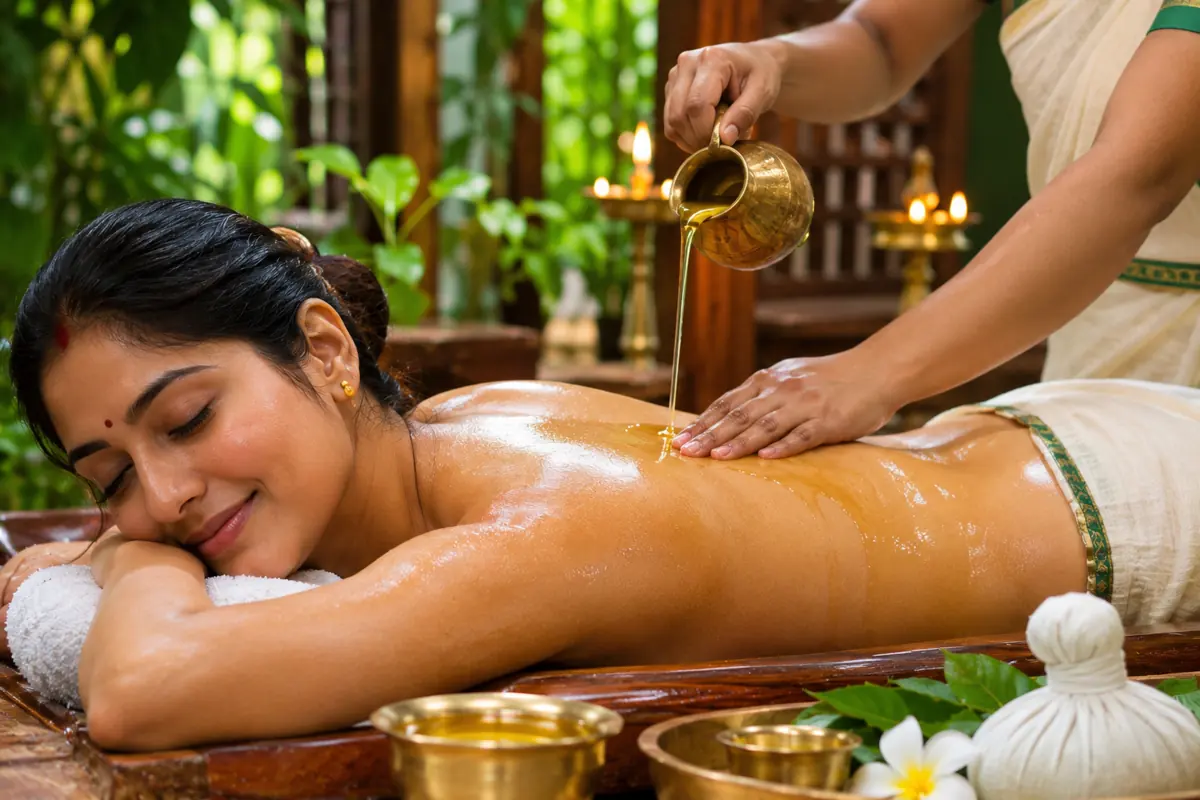
- Abhyanga: a warm herbal-oil massage of the legs and knees, often given by two therapists.
- Janu Basti: warm medicated oil held in a small reservoir around the knee for a period of time.
- Swedana: gentle sweating with steam or warm applications to ease stiffness.
- Njavarakizhi and Patra Pinda Sweda: warm boluses of medicated rice or herbal leaves pressed over the knee and leg muscles.
- Lepa: soothing herbal pastes applied to the knee and left for a short time.
- Herbal medicines and diet: preparations and warm meals chosen to suit your digestion.
Our guides to Kati Basti and Janu Basti and Njavarakizhi describe two of these in more detail.
A sample two-week rhythm
Every programme is individual, and this outline is only an illustration of how a stay can unfold.
- Days 1 to 3, settling in: arrival rest, a full consultation, review of scans and a gentle start with mild massage and light meals.
- Days 4 to 10, the main therapies: a daily rhythm of oil massage, Janu Basti or warm applications, herbal medicines, gentle exercise and rest, with the physician reviewing you each day.
- Days 11 to 14, consolidating: a lighter schedule, a review of how your knees feel, and a written plan for diet, exercises and routines at home.
Many guests extend to three weeks, and the physician will advise after the first review. Ask the centre for its own day-by-day plan.
Movement that helps the knees
Regular movement is one of the most helpful things you can do for a knee, and a residential stay makes it easy. Typical sessions include slow walking on level ground, gentle range-of-movement exercises on a mat, simple strengthening for the thigh muscles, and yoga postures adapted for the knees. Teachers show how to sit, stand and climb stairs in comfortable ways, and how to warm up before walking.
Everything is paced to your comfort. If a movement does not feel right, you simply leave it out, and the team offers a different one. Ask the centre to write your exercises down so that you can continue them at home.
Food, weight and sleep
Body weight places a load on the knees, so many guests welcome the chance to reset their eating habits. Meals in an Ayurvedic programme are simple and warm: soups, lightly spiced vegetables and grains and plenty of warm water, at regular times. The portions are sensible and the food is freshly cooked, so you can enjoy it. Your physician explains which foods suit you and why, and a good centre offers a short menu session so you can repeat the recipes at home.
Sleep follows the rhythm of the centre, with quiet evenings and an early night. Guests often say that a regular bedtime and a settled day do as much for their comfort as any single therapy.
Footwear, supports and everyday habits
Small practical choices make a difference to knees. Supportive, cushioned shoes, a walking stick or a lightweight knee support if your doctor recommends one, a raised seat and a chair with arms can all make daily life easier. At a residential centre you can try these without pressure and ask the team and your physiotherapist what suits you. Bring your usual shoes and supports and ask for a room with minimal stairs.
Kerala, climate and the best season
Many Ayurveda centres are in Kerala, where the warm, humid climate is traditionally considered kind to the body and the monsoon months are popular for oil therapies. The drier months from October to March are comfortable for travel and sightseeing. For knee problems, ask each centre which season it recommends, and whether rooms are air-conditioned or well ventilated. Short, flat walking routes and a ground-floor room can be helpful. Our guide to the best time to travel compares the seasons.
Keeping a simple diary
A small notebook is one of the most useful things to bring. Each evening, jot down how stiff your knees felt on waking, how far you walked, which stairs or seats were easy and what you ate. After a week or two the pattern often becomes clear, and you and the physician can fine-tune the plan. A simple one-to-ten comfort score each morning and evening makes progress easy to see. The same notes give your own doctor a helpful picture when you return.
Travelling comfortably
A little planning makes the journey smoother. Book an aisle seat so you can stand and stretch, keep your medicines and reports in your hand luggage, and choose a flight that arrives at a comfortable hour. Pack loose trousers or skirts that allow easy knee movement, and consider a cushion for long flights. Ask the centre to arrange the transfer and a restful first day. Our guide to the attendant visa explains how a family member can travel with you.
Conversations to have before you travel
A short chat with your own doctor makes the stay smoother. Many guests ask:
- Are my scans and medicines up to date for travel?
- Which exercises would you like me to continue?
- Is there anything you would like the Ayurveda team to know?
- When would you like to see me after I return?
Sharing the answers with the Ayurveda physician helps the two teams work in step, and leaves you feeling confident and well supported.
Who tends to enjoy a stay
Guests who enjoy knee programmes are often people with long-standing stiffness who want a calm place to move more, rest more and learn practical habits; those preparing for, or recovering from, a procedure who would like gentle support; and anyone who would like to start a healthy routine without the usual demands of daily life. If you are unsure whether a stay suits you, a free online consultation is a good first step, before you book anything.
Making the most of your free time
Between therapies there is time to enjoy the setting. Short strolls in the garden, reading in the shade, listening to music, gentle conversation with other guests or a visit to a nearby temple or backwater are all popular, and the team can suggest easy outings that fit your energy. Many guests find that this unhurried time is part of what helps their joints and spirits relax.
After you return
Many guests keep up a short morning stretch, warm simple meals, a daily walk and an earlier bedtime, and note how their knees feel over the following weeks. Ask the centre for a written summary of your programme, your diet and your exercises, and share it with your own doctor at your next visit. A follow-up video call with the physician a few weeks later is a good way to review how you are feeling. Our guide to continuing Ayurveda at home explains how to keep the benefits going.
Preparing for your stay
Pack supportive footwear, loose clothing and any knee supports you use, and ask about room location so walking distances suit you.
Planning your budget
Cost depends on room, length, therapies, physician time and medicines. Ask each centre for an itemised, dated quote for the same dates and inclusions, and add visa, flights, insurance and transfers. See the cost guide and verifying a doctor.
Travelling with confidence, and how MyVaidyam can help
- Share your scans, reports and medicine list with the Ayurveda physician before you travel.
- Continue your prescribed medicines, and tell your own doctor about your plans.
- Ask for ingredient lists for any herbal medicine, and choose labelled preparations.
- Plan comfortable seating and rest breaks for the flight.
MyVaidyam can arrange a free online pre-consultation, have your reports reviewed by an Ayurvedic physician and request day-by-day plans and itemised quotes from centres. Contact MyVaidyam to book your free online consultation.
Frequently Asked Questions on Ayurveda Programmes for Knee Osteoarthritis for International Patients in India
References
- NIAMS, US National Institutes of Health. Osteoarthritis: health topic overview
- Journal of Ayurveda and Integrative Medicine. Ayurveda-modern medicine interface: a critical appraisal of studies of Ayurvedic medicines to treat osteoarthritis and rheumatoid arthritis
- NCCIH, US National Institutes of Health. Ayurvedic medicine: in depth
- World Health Organization. WHO benchmarks for the practice of Ayurveda